The Nicomachean Ethics
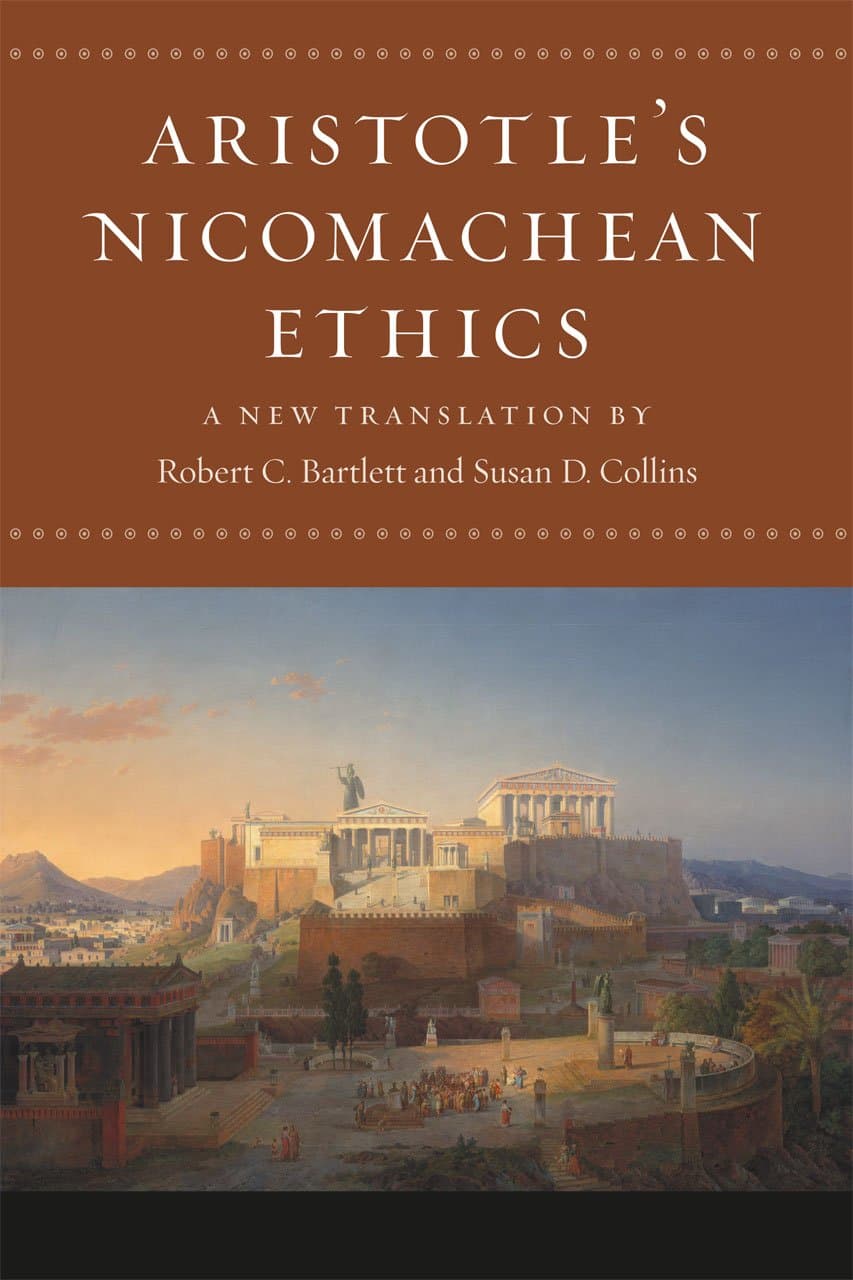
“One swallow does not make a summer, neither does one fine day; similarly one day or brief time of happiness does not make a person entirely happy.”
The Nicomachean Ethics Summary
Aristotle begins with a deceptively simple question: what is the good toward which all human activity aims? His answer—eudaimonia, often translated as happiness but meaning something closer to human flourishing or living well—sets in motion one of the most rigorous and humane investigations in the history of philosophy. Over ten books of sustained argument, Aristotle examines the virtues of character (courage, temperance, generosity, justice) and virtues of intellect (practical wisdom, scientific knowledge, philosophical contemplation), exploring how each contributes to a life well-lived. He investigates the nature of voluntary action, the role of pleasure and pain in moral development, the meaning of friendship in its many forms, and the relationship between individual excellence and the political community. The work builds toward the striking claim that the highest human activity is contemplation—the exercise of reason for its own sake—while never losing sight of the practical, embodied reality of ethical life.
The Nicomachean Ethics is not a set of commandments or a theoretical system imposed from above but a careful, empirical investigation of how human beings actually live and what makes their lives go well or badly. Aristotle's method is to begin with common opinions, refine them through dialectical argument, and arrive at conclusions that honor the complexity of moral experience. His concept of virtue as a mean between extremes, his insistence that ethics cannot be reduced to rules but requires the cultivated judgment of practical wisdom, and his vision of the good life as one of active excellence within a community have shaped moral philosophy for over two thousand years. It remains the single most influential work of ethics ever written.
Why Read The Nicomachean Ethics?
The Nicomachean Ethics is not a dusty relic of ancient thought—it is a living conversation about the questions that matter most: How should I live? What does it mean to be a good person? What makes a life genuinely worthwhile? Aristotle approaches these questions not as abstractions but as practical problems, and his answers have a startling directness that cuts through centuries of philosophical jargon. His insight that virtue is not a feeling or a rule but a habitual disposition—something you become through practice, the way a musician becomes skilled through playing—remains one of the most powerful ideas in moral philosophy.
Reading Aristotle gives you a framework for thinking about your own life with remarkable clarity. His analysis of friendship alone is worth the effort: he distinguishes friendships of utility, pleasure, and genuine virtue with a precision that will make you reconsider every important relationship you have. His insistence that ethics requires not just knowledge but character, not just good intentions but practical wisdom, speaks directly to a modern world awash in moral certainty and short on moral judgment. This is philosophy as it was meant to be—not a spectator sport but a guide to living.
About Aristotle
Aristotle was born in 384 BCE in Stagira, a small town in northern Greece near the border of Macedonia. His father, Nicomachus, served as personal physician to King Amyntas of Macedon, a connection that would later prove fateful. At seventeen, Aristotle traveled to Athens and entered Plato's Academy, where he studied and taught for twenty years until Plato's death. He subsequently tutored the young Alexander the Great before returning to Athens to found his own school, the Lyceum, where he conducted research and delivered lectures while walking its covered walkways—earning his followers the name Peripatetics.
Aristotle's intellectual range is virtually without parallel in human history. He made foundational contributions to logic, metaphysics, ethics, politics, biology, physics, psychology, rhetoric, and poetics, effectively creating several of these disciplines from nothing. The Nicomachean Ethics, likely named for his son Nicomachus who may have edited the text, stands alongside the Politics and the Poetics as his most enduring works. His influence dominated Western thought for nearly two millennia, shaping Islamic philosophy, medieval scholasticism, and the development of modern science. He died in 322 BCE in Chalcis, having shaped the intellectual architecture of Western civilization more profoundly than perhaps any other single individual.
Reading Guide
Ranked #388 among the greatest books of all time, The Nicomachean Ethics by Aristotle has earned its place in the literary canon. Originally written in Ancient Greek and published in -334, this challenging read from Greece continues to resonate with readers today.
This book belongs to our Philosophy & Faith collection, where you can discover more books that share its spirit and themes.
If you enjoy challenging reads like this one, you might also like Ulysses, Moby-Dick, or Lolita.
From the Philosophy & Faith Collection
If you enjoyed The Nicomachean Ethics, discover more masterpieces that share its spirit.
 #11View Book
Crime and Punishment
Fyodor Dostoevsky
High•20-25 hours #18View Book
The Bible
Various
Variable•60-80 hours #19View Book
The Brothers Karamazov
Fyodor Dostoevsky
Very High•35-40 hours #21View Book
The Stranger
Albert Camus
Moderate•3-4 hours
Browse more collections