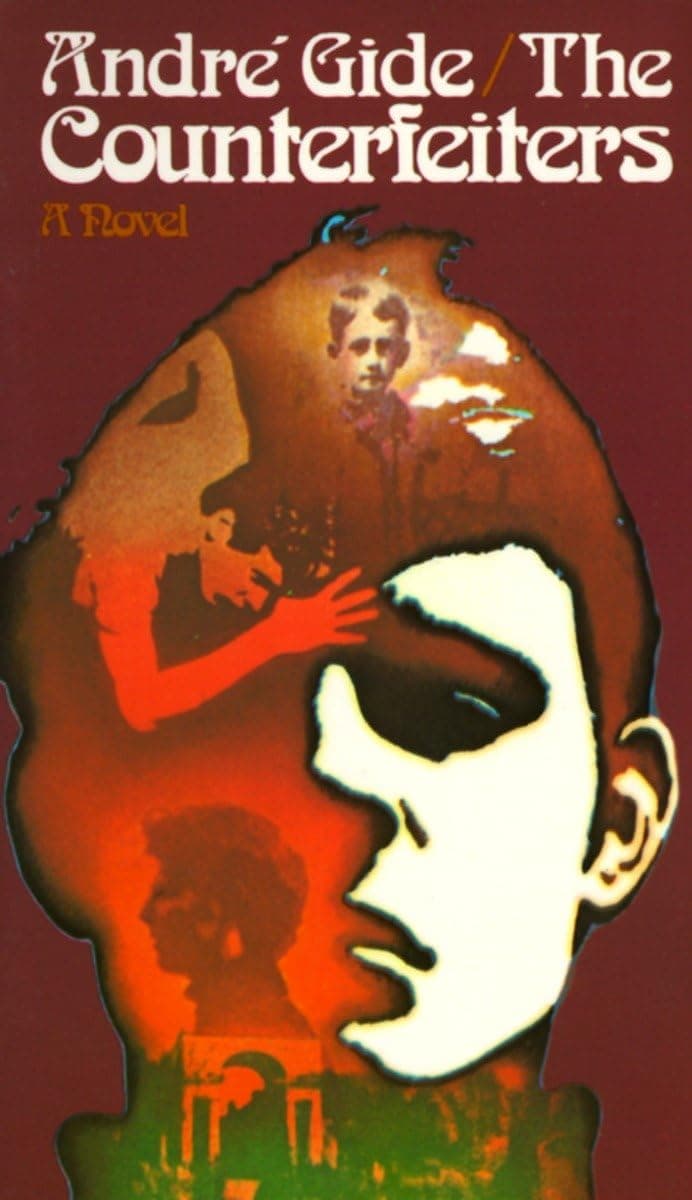
The Counterfeiters
“The novelist, be he Balzac or Dostoevsky, does not begin by generalizing. It is you who do that. He particularizes.”
The Counterfeiters Summary
Edouard, a novelist, is writing a novel called The Counterfeiters—and so is Andre Gide. This hall-of-mirrors structure is the engine of one of the most audaciously experimental works of twentieth-century fiction. Beneath the metafictional scaffolding swirls a kaleidoscopic portrait of Parisian youth: Bernard Profitendieu discovers he is illegitimate and runs away from home; his friend Olivier falls under the influence of the sinister literary editor Passavant; a ring of schoolboys circulates counterfeit coins; and the saintly young Boris, manipulated by cruel classmates, hurtles toward a shattering climax. Love affairs—heterosexual and homosexual—intersect with questions of authenticity, rebellion, and the masks people wear.
Gide called this his only true 'novel,' dismissing his other works as 'recits' or tales, and the distinction is telling. The Counterfeiters refuses the conventions of realist fiction—linear plot, omniscient narration, tidy resolution—in favor of a structure that mirrors the counterfeiting at its thematic core: what is genuine and what is false in art, in morality, in human relationships? The novel-within-a-novel device allows Gide to interrogate the very act of storytelling, while the multiplicity of characters and plotlines creates a panoramic portrait of a society in which every value is up for negotiation. It is a novel about the impossibility of sincerity in a world built on performance—and one of the key texts of literary modernism.
Why Read The Counterfeiters?
The Counterfeiters is one of those rare novels that makes you see fiction itself differently. Gide's daring—a novelist writing about a novelist writing about the novel you are reading—sounds like a parlor trick, but in practice it becomes a profound investigation of authenticity in an age of surfaces. Every character is performing a version of themselves, circulating in society like the counterfeit coins that give the book its title, and Gide forces you to ask: how do you tell the real from the false, in art or in life?
Beyond its formal innovations, this is a deeply human novel about young people struggling to find their identities in a world that offers them only masks. Gide's treatment of homosexuality—frank, unashamed, revolutionary for 1925—broke literary taboos and cost him dearly in reputation. Yet The Counterfeiters endures not as a period piece but as a living, restless work that anticipates postmodernism by half a century. If you have ever questioned whether the story you tell about yourself is the true one, this novel will feel uncannily, uncomfortably relevant.
About André Gide
Andre Gide (1869-1951) was born in Paris to a wealthy Protestant family and raised in an atmosphere of strict moral rectitude that he spent his life both absorbing and rebelling against. He studied at the Ecole Alsacienne and began publishing in his early twenties, quickly establishing himself as a central figure in French literary life. His travels to North Africa in the 1890s awakened him to his homosexuality, a realization that shaped his work and his tumultuous personal life, including his marriage to his cousin Madeleine Rondeaux.
Gide's body of work is vast and varied—novels, journals, criticism, political writing, autobiography—and is unified by an unflinching commitment to intellectual honesty. He championed individual freedom against dogma of every kind, drawing attacks from both the Catholic right and the Communist left. He won the Nobel Prize in Literature in 1947. His major works include The Immoralist, Strait Is the Gate, and The Counterfeiters, the last of which remains his most ambitious achievement—a novel that opened new possibilities for fiction and influenced writers from Sartre and Camus to the French New Novel and beyond.
Reading Guide
Ranked #202 among the greatest books of all time, The Counterfeiters by André Gide has earned its place in the literary canon. Originally written in French and published in 1925, this challenging read from France continues to resonate with readers today.
This book belongs to our Modern Mind and Society & Satire collections, where you can discover more books that share its spirit and themes.
If you enjoy challenging reads like this one, you might also like Ulysses, Moby-Dick, or Lolita.
From the Modern Mind Collection
If you enjoyed The Counterfeiters, discover more masterpieces that share its spirit.
 #1View Book
Ulysses
James Joyce
Challenging•35-40 hours #2View Book
In Search of Lost Time
Marcel Proust
High•100+ hours #8View Book
The Sound and the Fury
William Faulkner
Very High•12-15 hours #13View Book
Lolita
Vladimir Nabokov
Challenging•12-15 hours
Browse more collections