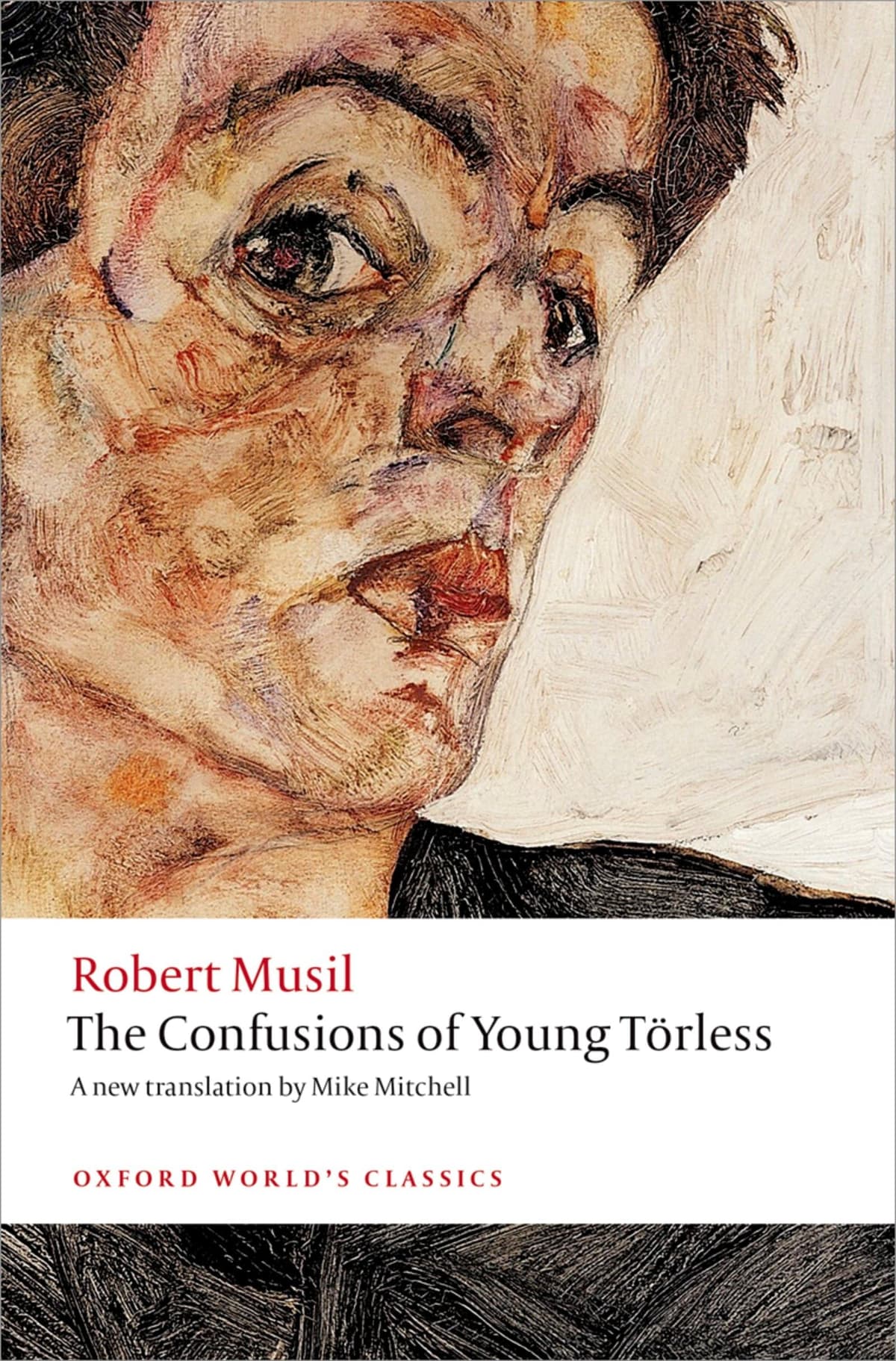
The Confusions of Young Törless
“What is it in us that lies, murders, steals? ... What world do we enter then? What other world?”
The Confusions of Young Törless Summary
At an elite military boarding school in the remote Austrian provinces, the adolescent Torless observes and participates in the systematic abuse of a fellow student, Basini, who has been caught stealing. Two of Torless's classmates, the sadistic Beineberg and the coldly calculating Reiting, take it upon themselves to punish Basini through escalating acts of humiliation and violence. Torless watches with a mixture of fascination and revulsion, drawn less by cruelty itself than by the philosophical questions it provokes: How can rational systems of thought coexist with irrational impulses? What lies beneath the orderly surface of civilized society? His attempts to articulate these troubling insights through the lens of mathematics, particularly the concept of imaginary numbers, reveal a mind struggling to bridge the gap between logic and the murky depths of human experience.
Musil's debut novel is a prescient and disturbing exploration of the psychological conditions that would later make possible the horrors of twentieth-century authoritarianism. Written in 1906, decades before the rise of fascism, it anatomizes the mechanisms of group cruelty, the seduction of power, and the intellectual paralysis of the bystander with unsettling precision. Torless's inability to act on his moral intuitions, his retreat into abstract thought as violence escalates around him, makes him one of the most troubling and psychologically complex figures in modern literature. The novel's spare, analytic prose carries a tension that builds relentlessly, and its examination of the intersection between sexuality, power, and intellect anticipates the concerns of later writers from Kafka to Coetzee.
Why Read The Confusions of Young Törless?
Musil's slim, devastating novel strikes with the force of a philosophical grenade. Set within the claustrophobic walls of a military academy, it transforms a story of adolescent bullying into a profound inquiry into the nature of evil, the limits of reason, and the terrifying ease with which civilized people become complicit in brutality. The young Torless is not a villain but something perhaps more disturbing: an intelligent observer who recognizes cruelty for what it is yet cannot summon the will to intervene.
Written in 1906, the novel reads as an eerie prophecy of the moral catastrophes that would engulf Europe in the decades to come. Its exploration of how institutional environments breed conformity and sadism feels as relevant today as it did a century ago. The prose is precise and unsettling, and the novel's engagement with mathematics as a metaphor for the incomprehensible aspects of existence gives it a unique intellectual depth. At barely two hundred pages, it demands and repays close attention, offering one of the most psychologically acute portraits of adolescence and moral failure in all of literature.
About Robert Musil
Robert Musil was born in Klagenfurt, Austria, in 1880 into a family of engineers and academics. He trained as a military officer and engineer before turning to philosophy and psychology, studying under the pioneering experimental psychologist Carl Stumpf in Berlin. His first novel, The Confusions of Young Torless, published in 1906, drew on his own experiences at military boarding school and established him as a significant literary voice. He served as an officer in World War I, an experience that deepened his preoccupation with the failures of rationalism and institutional authority.
Musil is best known for his monumental, unfinished novel The Man Without Qualities, one of the great intellectual achievements of twentieth-century literature. Working on this vast project consumed the latter decades of his life, during which he lived in increasing poverty and obscurity, first in Vienna and then in Swiss exile after fleeing the Nazi annexation of Austria. He died in Geneva in 1942, virtually unknown. In the decades since, his reputation has grown enormously, and he is now recognized as one of the most important novelists of the modern era, a writer whose fusion of philosophical rigor and psychological insight has few equals in any language.
Reading Guide
Ranked #291 among the greatest books of all time, The Confusions of Young Törless by Robert Musil has earned its place in the literary canon. Originally written in German and published in 1906, this moderate read from Austria continues to resonate with readers today.
This book belongs to our Gothic & Dark and Modern Mind collections, where you can discover more books that share its spirit and themes.
If you enjoy moderate reads like this one, you might also like One Hundred Years of Solitude, Nineteen Eighty-Four, or Wuthering Heights.
From the Gothic & Dark Collection
If you enjoyed The Confusions of Young Törless, discover more masterpieces that share its spirit.
 #15View Book
Wuthering Heights
Emily Brontë
Moderate•10-12 hours #29View Book
Jane Eyre
Charlotte Brontë
Accessible•15-20 hours #41View Book
Frankenstein
Mary Shelley
Accessible•6-8 hours #44View Book
Absalom, Absalom!
William Faulkner
Very High•12-15 hours
Browse more collections