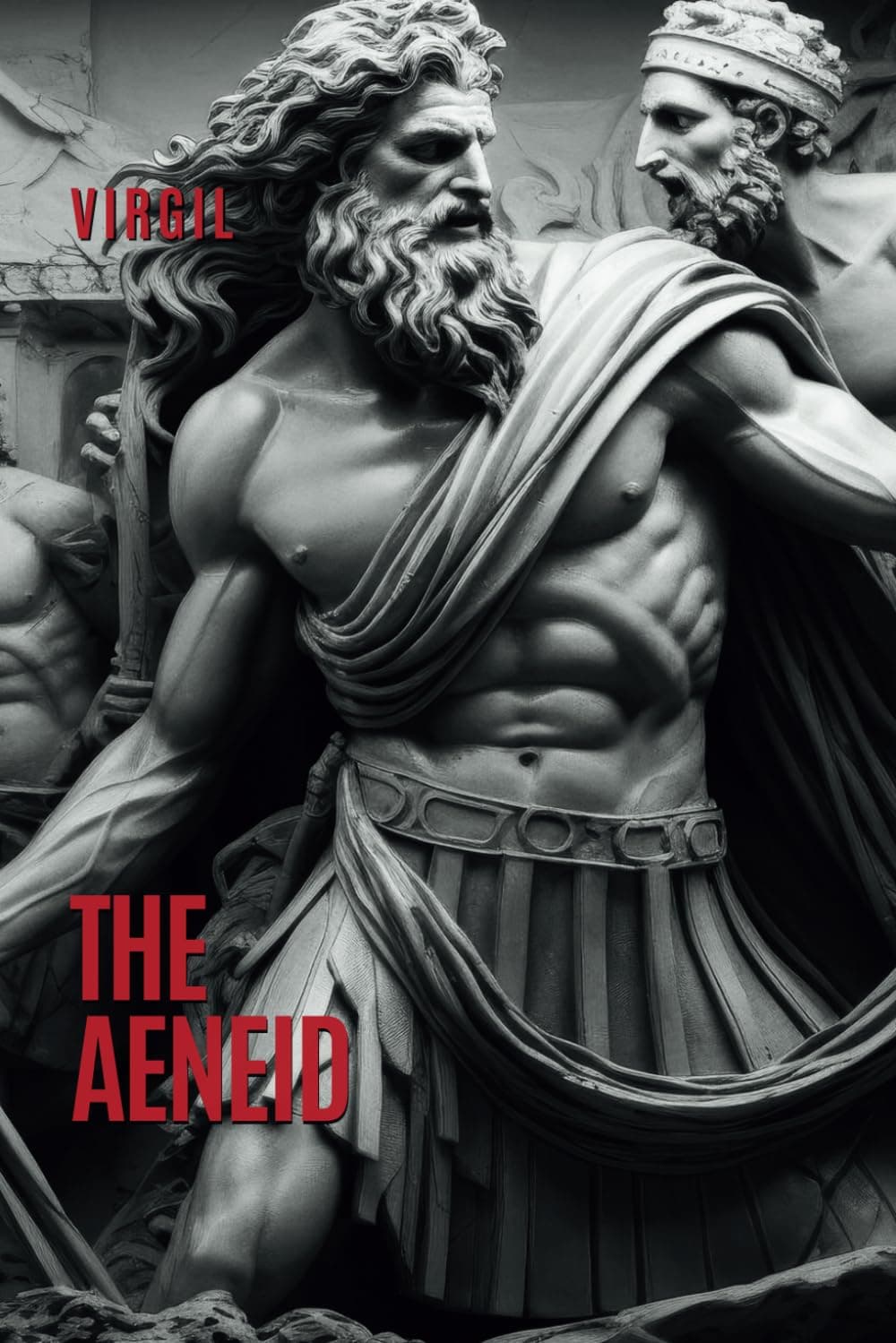
The Aeneid
“I sing of arms and the man, who first from the shores of Troy, exiled by fate, came to Italy and Lavinian shores.”
The Aeneid Summary
Troy has fallen. From its ashes, the Trojan prince Aeneas flees with his aged father on his back and his young son by the hand, carrying the household gods of a destroyed civilization. Commanded by fate and the gods to found a new kingdom in Italy, he sails the Mediterranean through storms conjured by a vengeful Juno, descends into the underworld to speak with the dead, and wages a brutal war against the Latin peoples who already inhabit the promised land. Along the way, he loves and abandons Queen Dido of Carthage, whose suicide becomes one of literature's great tragedies of passion.
Virgil's epic is the foundational poem of Roman civilization—a story of exile, duty, and the terrible cost of empire. Unlike Homer's heroes, Aeneas is defined not by rage or cunning but by pietas—devotion to gods, country, and family—even when that devotion demands the sacrifice of everything he loves. The Aeneid is a poem that glorifies Rome while mourning what Rome destroyed, and that tension gives it a depth and ambiguity that has haunted readers for two thousand years.
Why Read The Aeneid?
The Aeneid is the poem that built an empire—and then quietly questioned whether the empire was worth the price. Virgil wrote it as the story of Rome's divine destiny, but what emerges is something far more complex: a meditation on the human cost of civilization. Aeneas does his duty, follows the will of the gods, and founds the greatest city in history—but he leaves behind a trail of broken hearts, burned cities, and slaughtered enemies. Virgil forces you to ask whether a nation born in blood can ever escape its origins.
Two thousand years after its composition, the Aeneid remains the essential bridge between the ancient Greek world and the civilization that would become Europe. Dante chose Virgil as his guide through Hell for a reason: no poet has ever understood better the intersection of human suffering and divine purpose. To read the Aeneid is to encounter the origin story of the West—told by a poet clear-eyed enough to see its grandeur and its guilt.
About Virgil
Virgil (70–19 BC), born Publius Vergilius Maro in the village of Andes near Mantua, rose from provincial origins to become the greatest poet of the Roman world. His early works—the pastoral Eclogues and the agricultural Georgics—established him as the heir to the Greek literary tradition, and his patron Augustus commissioned the Aeneid as the definitive epic of Roman destiny.
Virgil spent the last eleven years of his life composing the Aeneid, and on his deathbed reportedly asked that the unfinished manuscript be burned. Augustus overruled the request, and the poem was published posthumously. It became the cornerstone of Roman education, the most copied text of the Middle Ages, and the single most influential poem in the Western tradition. Virgil's ghost walks through all of European literature—from Dante to Milton to Seamus Heaney.
Reading Guide
Ranked #65 among the greatest books of all time, The Aeneid by Virgil has earned its place in the literary canon. Originally written in Latin and published in 19 BC, this challenging read from Rome continues to resonate with readers today.
This book belongs to our Epics and Philosophy & Faith collections, where you can discover more books that share its spirit and themes.
If you enjoy challenging reads like this one, you might also like Ulysses, Moby-Dick, or Lolita.
From the Epics Collection
If you enjoyed The Aeneid, discover more masterpieces that share its spirit.
 #1View Book
Ulysses
James Joyce
Challenging•35-40 hours #5View Book
One Hundred Years of Solitude
Gabriel García Márquez
Moderate•15-20 hours #7View Book
Moby-Dick
Herman Melville
Challenging•20-25 hours #9View Book
Don Quixote
Miguel de Cervantes
High•35-40 hours
Browse more collections