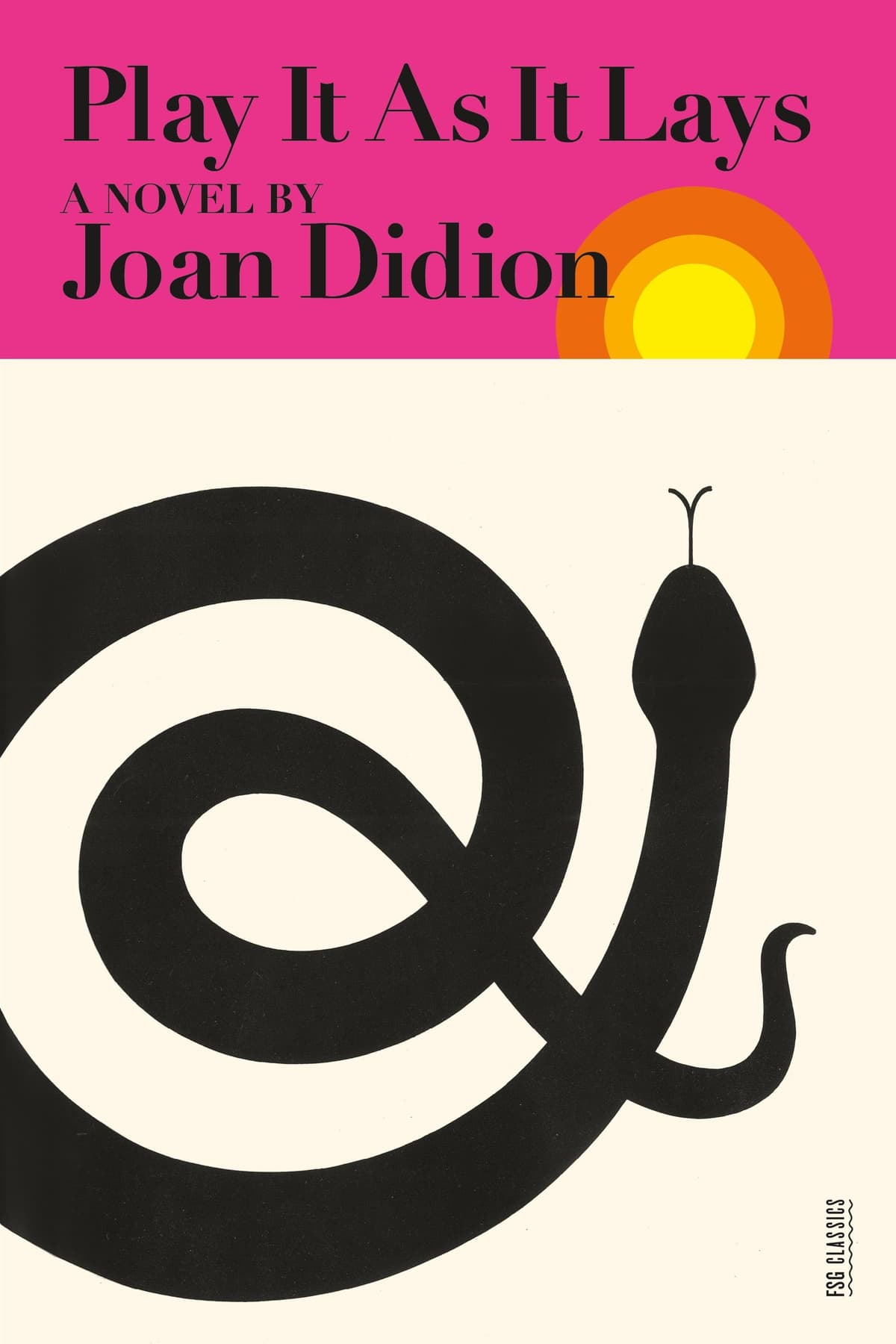
Play It As It Lays
“I know what nothing means, and keep on playing.”
Play It As It Lays Summary
Maria Wyeth is a woman in pieces. A former model and sometime actress living in Los Angeles and its margins, Maria spends her days driving the freeways in an aimless, hypnotic circuit, moving between her rented house, the hospital where her brain-damaged daughter Kate is institutionalized, and the homes of various people who want something from her or to whom she once meant something. Her estranged husband Carter, a film director, has left her. Her friend BZ is spiraling toward nihilism. Her agent and her lawyer negotiate the wreckage of her career. Through fragmented, elliptical chapters, some only a few lines long, Joan Didion reconstructs the story of Maria's dissolution: a failed marriage, an abortion coerced by Carter, a series of empty sexual encounters, and the relentless Southern California sun beating down on a landscape stripped of meaning. The novel is structured as a series of testimonies and memories, framed by Maria's voice from what appears to be a psychiatric facility, where she plays it as it lays, holding on to nothing because nothing is all there is to hold.
Play It As It Lays is a masterwork of American minimalism, a novel that achieves its devastating effects through what it refuses to say. Didion's prose is surgical, every sentence pared to the bone, and the white space between chapters carries as much weight as the words themselves. The novel captures a specific time and place, Hollywood at the end of the 1960s, but its vision of spiritual emptiness transcends its setting. Maria Wyeth is one of the great portraits of female despair in American fiction, a woman whose suffering is inseparable from the culture that produced her. Didion anatomizes a world in which glamour and horror coexist without friction, where an abortion and a pool party occupy the same moral plane, and where the only victory is the refusal to be destroyed, even when one cannot articulate what survival means.
Why Read Play It As It Lays?
Play It As It Lays will take you only a few hours to read, and it will haunt you for far longer. Joan Didion strips the novel down to its skeleton, and what remains is pure nerve. If you have ever felt the particular emptiness that comes from living in a culture that offers everything and means nothing, Maria Wyeth's story will feel uncomfortably familiar. Didion does not sentimentalize her protagonist or offer easy explanations for her suffering. Instead, she gives you the texture of a mind in crisis with a precision that is almost clinical, and the effect is more disturbing than any overwrought depiction of despair could be.
This is also one of the great Los Angeles novels, capturing the city not as a place of dreams but as a place where dreams go to die in beautiful weather. Didion understands that the horror of Southern California is not its corruption but its indifference, and she renders that understanding in prose so clean it cuts. If you care about American fiction, about what the novel can do when it abandons conventional narrative and trusts the intelligence of its reader, Play It As It Lays is essential. It is a small book that contains a void.
About Joan Didion
Joan Didion was born in 1934 in Sacramento, California, into a family that had been in the state for five generations. She won Vogue magazine's Prix de Paris writing contest while still at Berkeley, moved to New York, and worked as a magazine writer before returning to California with her husband, the writer John Gregory Dunne. Her essays for The Saturday Evening Post and Life, later collected in Slouching Towards Bethlehem, established her as one of the defining voices of the 1960s counterculture's aftermath, a writer who could see the fault lines beneath the surface of American life.
Didion's literary career spanned five decades and encompassed novels, screenplays, and some of the most celebrated nonfiction of the twentieth century. Her essay collections, including The White Album and After Henry, redefined the personal essay as a form of cultural criticism. Her late memoir The Year of Magical Thinking, written after Dunne's sudden death, became a landmark of grief literature. Didion's influence on American prose style is incalculable: her sentences, precise and rhythmic and devastating, taught a generation of writers that less could be infinitely more. She died in 2021, recognized as one of the essential American writers of her era.
Reading Guide
Ranked #447 among the greatest books of all time, Play It As It Lays by Joan Didion has earned its place in the literary canon. Originally written in English and published in 1970, this accessible read from United States continues to resonate with readers today.
This book belongs to our Modern Mind and American Spirit collections, where you can discover more books that share its spirit and themes.
If you enjoy accessible reads like this one, you might also like The Great Gatsby, The Catcher in the Rye, or Pride and Prejudice.
From the Modern Mind Collection
If you enjoyed Play It As It Lays, discover more masterpieces that share its spirit.
 #1View Book
Ulysses
James Joyce
Challenging•35-40 hours #2View Book
In Search of Lost Time
Marcel Proust
High•100+ hours #8View Book
The Sound and the Fury
William Faulkner
Very High•12-15 hours #13View Book
Lolita
Vladimir Nabokov
Challenging•12-15 hours
Browse more collections