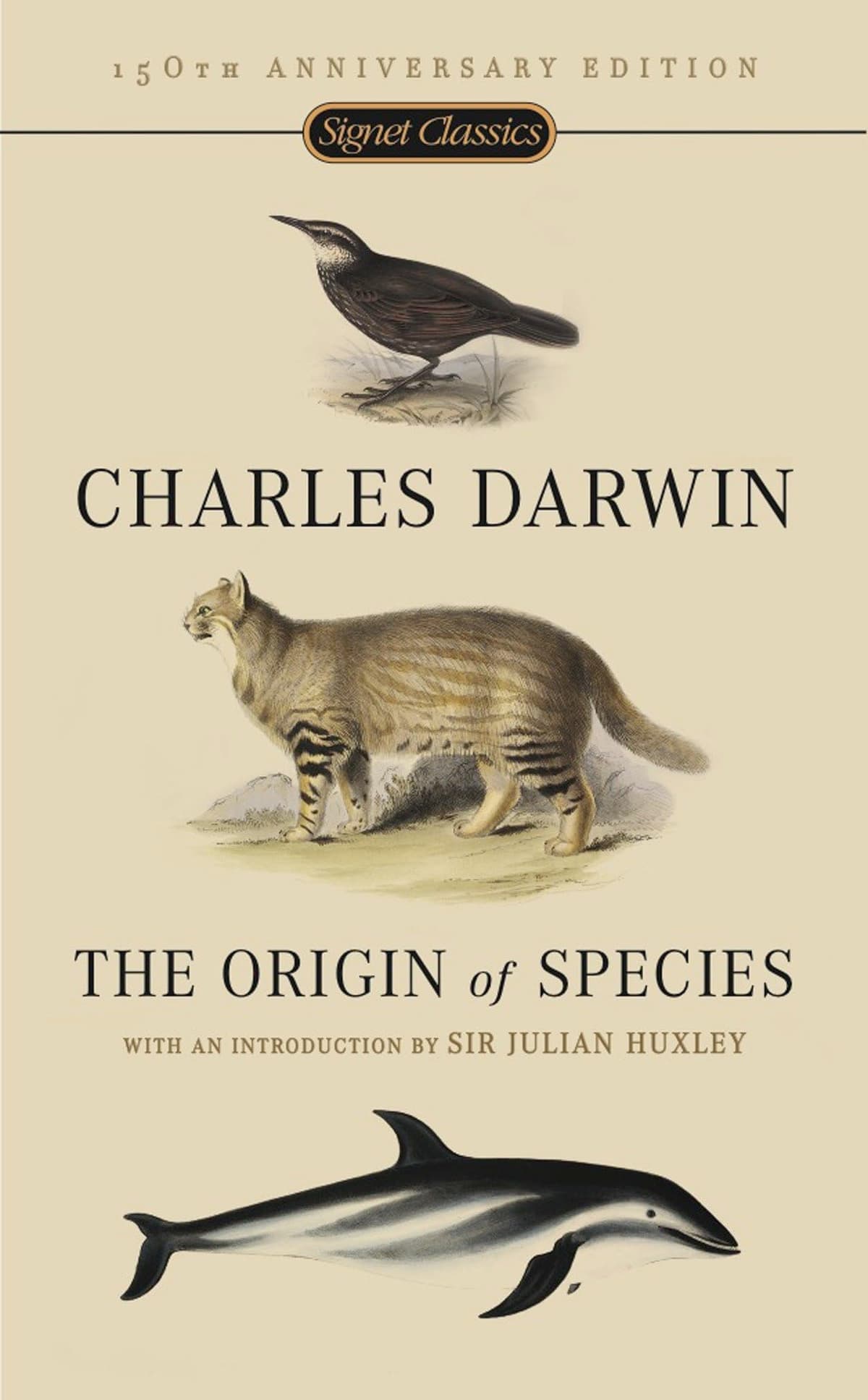
On the Origin of Species
“There is grandeur in this view of life, with its several powers, having been originally breathed into a few forms or into one; and that, whilst this planet has gone cycling on according to the fixed law of gravity, from so simple a beginning endless forms most beautiful and most wonderful have been, and are being, evolved.”
On the Origin of Species Summary
Charles Darwin spent over twenty years amassing evidence—from the beaks of Galápagos finches to the breeding habits of English pigeons, from the fossil record to the geographical distribution of species across continents and islands—before publishing the book that would overturn humanity's understanding of its place in nature. On the Origin of Species lays out, with patient and meticulous argument, the theory of natural selection: that organisms vary, that those variations which confer advantage in the struggle for existence tend to be preserved and inherited, and that over vast stretches of time this process produces the staggering diversity of life on Earth. There is no sudden revelation here, no thunderbolt; instead, Darwin builds his case brick by careful brick, drawing on botany, geology, paleontology, and animal husbandry.
What astonishes about the Origin is not only its revolutionary content but its literary quality. Darwin writes with the care of a Victorian essayist—his prose is lucid, courteous, and shot through with wonder at the "entangled bank" of nature. He anticipates objections with scrupulous honesty, acknowledges the gaps in his evidence, and yet carries the reader inexorably toward his conclusion. The book's final paragraph, with its vision of life evolving from a single origin into "endless forms most beautiful," is one of the great passages in English nonfiction. It changed biology, philosophy, and theology forever—and it remains, more than a century and a half later, one of the most consequential works the human mind has produced.
Why Read On the Origin of Species?
This is one of those rare books that divided human history into before and after. Before Darwin, the diversity of life was a mystery explained by divine fiat; after him, it became a story—an epic, still unfolding narrative of variation, competition, and adaptation stretching back billions of years. To read the Origin is to watch one of the greatest minds in history think its way, with extraordinary patience and intellectual courage, toward a truth that would shake every institution of his age.
You do not need a background in science to appreciate it. Darwin writes for the general reader, and his prose is warmer and more accessible than you might expect—full of observations about pigeons, orchids, and barnacles that make the abstract vivid. What stays with you is not just the theory but the temperament: the humility, the curiosity, the willingness to follow evidence wherever it leads. Reading Darwin will not only teach you how evolution works; it will show you what it looks like when a human being thinks honestly about the world.
About Charles Darwin
Charles Darwin (1809–1882) was born in Shrewsbury, England, into a distinguished family of scientists and freethinkers. He studied medicine at Edinburgh and theology at Cambridge before embarking, at the age of twenty-two, on the five-year voyage of HMS Beagle that would transform his understanding of the natural world. The specimens and observations he gathered—particularly in the Galápagos Islands—provided the foundation for his theory of evolution by natural selection, which he developed over two decades of painstaking research at his home in Down House, Kent.
Darwin delayed publication for years, aware of the theological and social upheaval his theory would cause, until Alfred Russel Wallace independently arrived at similar conclusions and forced his hand. On the Origin of Species appeared in 1859 and sold out its first printing on the day of publication. His subsequent works—The Descent of Man, The Expression of the Emotions in Man and Animals, and his studies of orchids, earthworms, and coral reefs—extended and deepened his revolutionary framework. He is buried in Westminster Abbey, a testament to the eventual acceptance of ideas that once scandalized the world.
Reading Guide
Ranked #171 among the greatest books of all time, On the Origin of Species by Charles Darwin has earned its place in the literary canon. Originally written in English and published in 1859, this challenging read from United Kingdom continues to resonate with readers today.
This book belongs to our Philosophy & Faith collection, where you can discover more books that share its spirit and themes.
If you enjoy challenging reads like this one, you might also like Ulysses, Moby-Dick, or Lolita.
From the Philosophy & Faith Collection
If you enjoyed On the Origin of Species, discover more masterpieces that share its spirit.
 #11View Book
Crime and Punishment
Fyodor Dostoevsky
High•20-25 hours #18View Book
The Bible
Various
Variable•60-80 hours #19View Book
The Brothers Karamazov
Fyodor Dostoevsky
Very High•35-40 hours #21View Book
The Stranger
Albert Camus
Moderate•3-4 hours
Browse more collections