Leviathan
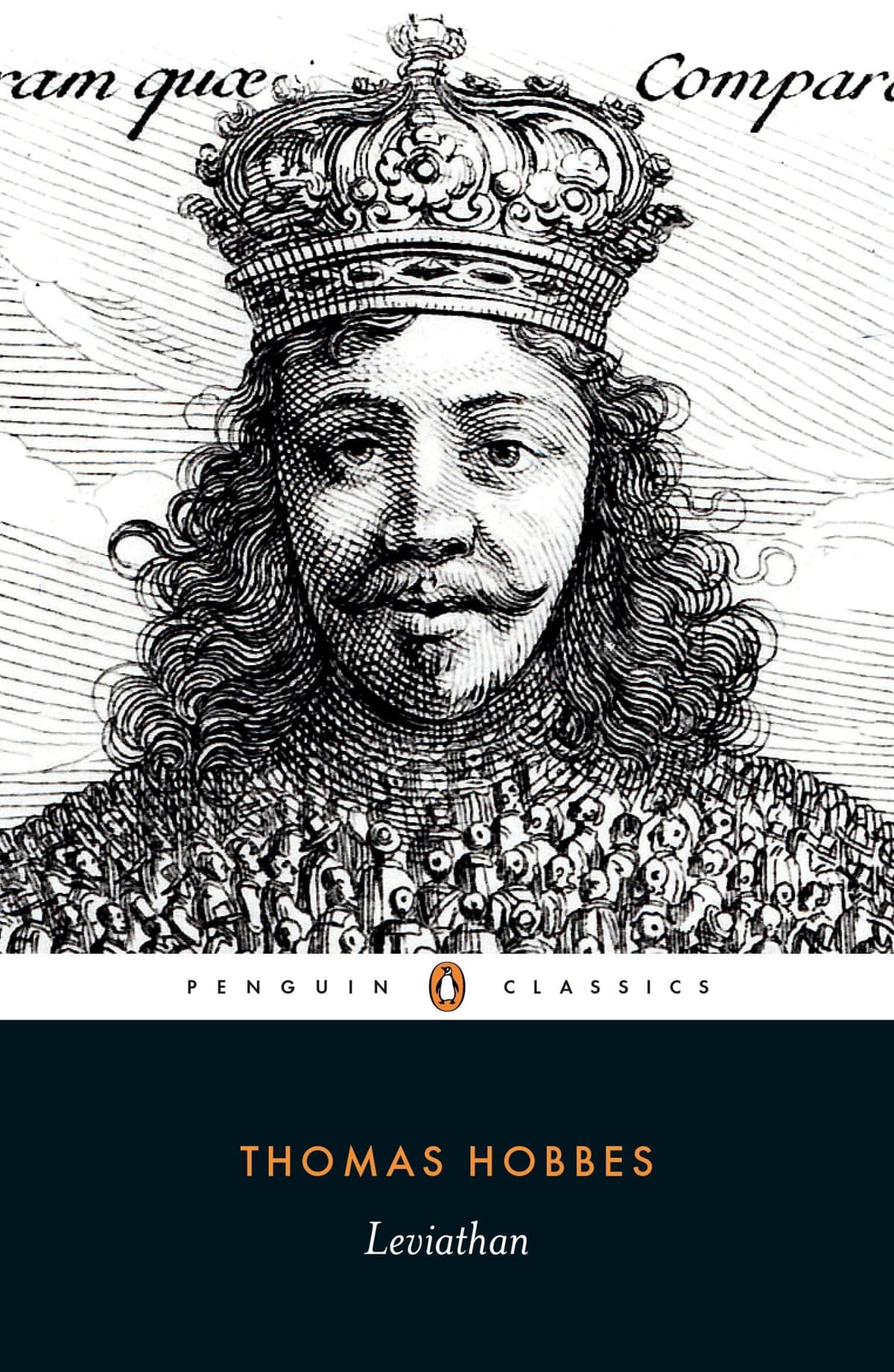
“During the time men live without a common power to keep them all in awe, they are in that condition which is called war; and such a war as is of every man against every man.”
Leviathan Summary
Written during the chaos of the English Civil War, Leviathan constructs a comprehensive theory of political authority from first principles. Hobbes begins with a materialist account of human nature, arguing that people are fundamentally driven by desire and aversion, and that in a hypothetical state of nature without government, life would be a war of all against all. This famous condition, in which existence is solitary, poor, nasty, brutish, and short, compels rational individuals to surrender their natural freedom to a sovereign authority through a social contract. The sovereign, whether a monarch or an assembly, holds absolute power not by divine right but by the consent of the governed, who trade liberty for security. Hobbes meticulously builds his argument through four parts, moving from the mechanics of human cognition and passion through the construction of the commonwealth and into a sustained critique of ecclesiastical power.
Leviathan represents a revolutionary break from medieval political theology by grounding sovereignty in human reason rather than divine mandate. Hobbes's insistence that political authority is an artificial creation, manufactured by individuals to escape their natural condition, makes him a founder of modern political philosophy and social contract theory. His argument that the church must be subordinate to the state and his materialist account of religion were deeply controversial in his own time and remain provocative today. The work profoundly influenced Locke, Rousseau, Kant, and the entire tradition of liberal political thought, even as many of these thinkers defined their positions in explicit opposition to Hobbes. It remains one of the foundational texts of Western political theory.
Why Read Leviathan?
Every debate about the proper scope of government, the balance between freedom and security, and the legitimacy of political authority traces its lineage back to this book. Hobbes writes with a logical rigor and rhetorical force that makes his arguments feel inescapable even when they are deeply unsettling. His portrait of the state of nature as a war of all against all remains the most powerful thought experiment in political philosophy, forcing readers to confront uncomfortable questions about what holds civilization together and how quickly it might come apart.
Engaging with Leviathan is not merely an academic exercise. In an era of political polarization, institutional distrust, and debates about the limits of state power, Hobbes's framework offers a bracing clarity. His insistence that political order is not natural but must be constructed and maintained through collective agreement speaks directly to contemporary anxieties about democratic fragility. Whether one ultimately agrees or disagrees with his conclusions, wrestling with Hobbes sharpens one's thinking about the most fundamental questions of political life.
About Thomas Hobbes
Thomas Hobbes was born in 1588 in Westport, England, reportedly prematurely when his mother was frightened by news of the approaching Spanish Armada. Educated at Oxford, he spent much of his career as a tutor and intellectual companion to aristocratic families, traveling widely in Europe and engaging with the leading scientific and philosophical minds of his era, including Galileo and Descartes. The upheaval of the English Civil War, during which he lived in exile in Paris, provided the immediate impetus for Leviathan, published in 1651.
Hobbes's materialism and his subordination of religious authority to the state earned him powerful enemies on all sides. Royalists distrusted his contractarian basis for sovereignty, parliamentarians rejected his defense of absolute power, and churchmen condemned his apparent atheism. Despite these controversies, he lived to the remarkable age of ninety-one, continuing to write on mathematics, history, and philosophy until shortly before his death in 1679. His influence on Western thought is immense: he essentially invented modern political philosophy, and his concepts of the social contract, the state of nature, and sovereignty remain central to political discourse more than three centuries later.
Reading Guide
Ranked #330 among the greatest books of all time, Leviathan by Thomas Hobbes has earned its place in the literary canon. Originally written in English and published in 1651, this challenging read from United Kingdom continues to resonate with readers today.
This book belongs to our Philosophy & Faith collection, where you can discover more books that share its spirit and themes.
If you enjoy challenging reads like this one, you might also like Ulysses, Moby-Dick, or Lolita.
From the Philosophy & Faith Collection
If you enjoyed Leviathan, discover more masterpieces that share its spirit.
 #11View Book
Crime and Punishment
Fyodor Dostoevsky
High•20-25 hours #18View Book
The Bible
Various
Variable•60-80 hours #19View Book
The Brothers Karamazov
Fyodor Dostoevsky
Very High•35-40 hours #21View Book
The Stranger
Albert Camus
Moderate•3-4 hours
Browse more collections