I'm Not Stiller
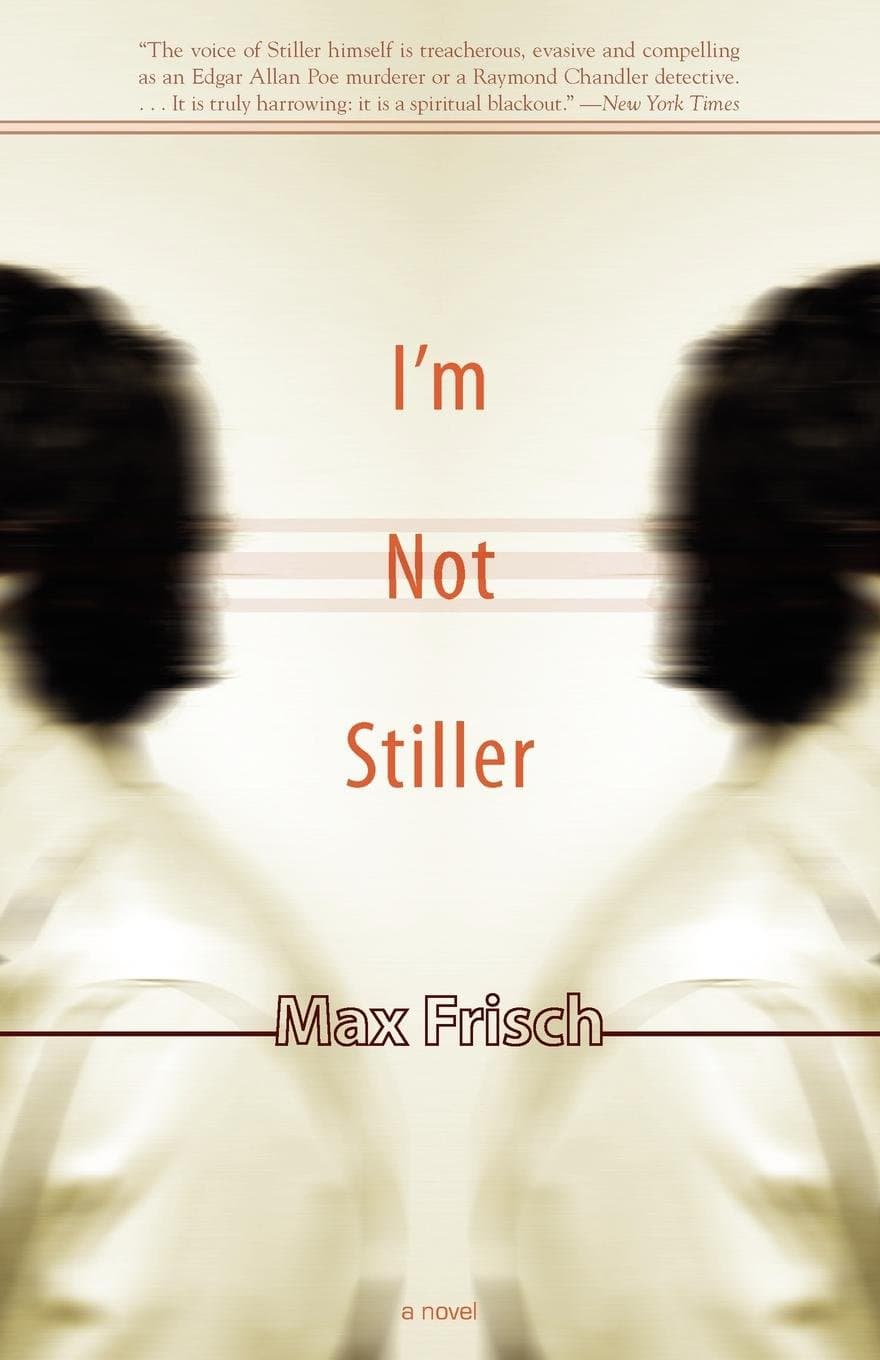
“I'm not Stiller!”
I'm Not Stiller Summary
A man is arrested at the Swiss border and thrown into prison, where he insists with increasing desperation that he is not the person the authorities believe him to be. The prisoner claims to be James Larkin White, an American sculptor, but the Swiss government is convinced he is the missing Zurich architect Anatol Ludwig Stiller, who disappeared six years earlier. Through a series of notebooks written in his cell, the prisoner recounts elaborate stories of his supposed adventures in America and Mexico, tales of gunfights, love affairs, and exotic encounters that read like feverish inventions. Meanwhile, the people from Stiller's past, his estranged wife Julika, his friends, his former lover, parade through the prison to identify him, each offering their own version of who Stiller was. The question of whether the prisoner truly is Stiller becomes secondary to a deeper, more unsettling question: can a person refuse to be who they have been, and can identity be willed into something new?
Max Frisch's novel is a brilliant, formally inventive exploration of identity, self-deception, and the impossibility of escaping one's own history. The structure, alternating between the prisoner's unreliable notebooks and an epilogue narrated by Stiller's prosecutor friend, creates a hall of mirrors in which truth and fabrication become indistinguishable. Frisch writes with the precision of a Swiss watchmaker and the philosophical restlessness of an existentialist, probing the ways in which society, memory, and intimate relationships conspire to fix us in identities we may never have chosen. The novel's examination of marriage, artistic failure, and the gap between the self we imagine and the self others perceive remains startlingly contemporary.
Why Read I'm Not Stiller?
I'm Not Stiller is one of the great novels of identity, and it will leave you questioning whether anyone truly knows who they are. Max Frisch constructs a narrative trap of exquisite ingenuity: a man in a prison cell, insisting he is not the person everyone says he is, spinning wild stories of a life that may be pure invention. As you read, you find yourself drawn into a game that grows increasingly vertiginous, where the line between truth and performance dissolves completely. The prisoner's refusal to accept his past becomes a philosophical drama of the highest order, and Frisch's dry, precise prose makes every revelation feel like the turning of a lock.
This novel speaks directly to anyone who has ever felt trapped by the expectations of others, by the roles society assigns, or by the person they used to be. Frisch understood, decades before our age of reinvention and self-branding, that identity is both a prison and a performance, and that the desire to become someone new can be the most honest and the most delusional impulse a person can have. I'm Not Stiller is also a devastating portrait of a marriage, of the ways two people can fail each other while remaining locked together. It is essential reading for anyone interested in the European novel at its most intellectually alive.
About Max Frisch
Max Frisch was born in 1911 in Zurich, Switzerland, the son of an architect. He studied German literature at the University of Zurich but abandoned his studies after his father's death to work as a journalist, traveling across Europe. He later trained as an architect and practiced the profession for over a decade, even winning a major competition for a public swimming pool in Zurich, before devoting himself entirely to writing. His personal life was marked by restless movement between relationships and countries, including a famous and turbulent friendship with fellow Swiss-German writer Friedrich Durrenmatt.
Frisch became one of the most important European writers of the twentieth century, equally celebrated as a novelist and playwright. His novels, including I'm Not Stiller, Homo Faber, and Montauk, are searching examinations of identity, guilt, and the failure of self-knowledge. His plays, particularly The Fire Raisers and Andorra, are powerful parables of political complicity and moral cowardice. Frisch's work is characterized by formal experimentation, a skeptical intelligence, and an unflinching honesty about the contradictions of modern life. He received numerous honors, including the Georg Buchner Prize and the Neustadt International Prize for Literature. He died in Zurich in 1991, leaving behind a body of work that remains central to the European literary tradition.
Reading Guide
Ranked #427 among the greatest books of all time, I'm Not Stiller by Max Frisch has earned its place in the literary canon. Originally written in German and published in 1954, this moderate read from Switzerland continues to resonate with readers today.
This book belongs to our Modern Mind and Philosophy & Faith collections, where you can discover more books that share its spirit and themes.
If you enjoy moderate reads like this one, you might also like One Hundred Years of Solitude, Nineteen Eighty-Four, or Wuthering Heights.
From the Modern Mind Collection
If you enjoyed I'm Not Stiller, discover more masterpieces that share its spirit.
 #1View Book
Ulysses
James Joyce
Challenging•35-40 hours #2View Book
In Search of Lost Time
Marcel Proust
High•100+ hours #8View Book
The Sound and the Fury
William Faulkner
Very High•12-15 hours #13View Book
Lolita
Vladimir Nabokov
Challenging•12-15 hours
Browse more collections