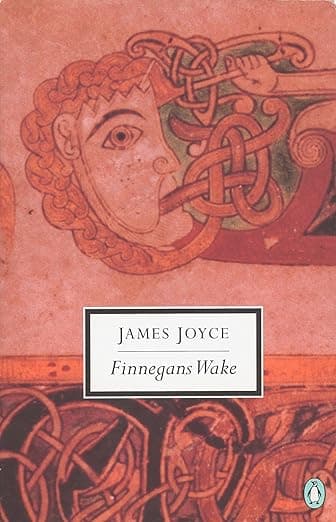
Finnegans Wake
“Three quarks for Muster Mark!”
Finnegans Wake Summary
Finnegans Wake unfolds as a single night's dream of Humphrey Chimpden Earwicker (HCE), a Dublin publican who lies sleeping above his tavern in Chapelizod while the entire history of human civilization cycles through his unconscious mind. HCE is haunted by an obscure sin committed in Phoenix Park, possibly an act of voyeurism or exhibitionism witnessed by two girls and three soldiers, though the nature of his transgression shifts and multiplies with each retelling. Around him orbit his wife Anna Livia Plurabelle (ALP), embodiment of the River Liffey and all feminine creative force; their twin sons Shem the Penman and Shaun the Post, who represent the eternal opposition between the artist and the man of action; and their daughter Issy, a figure of narcissistic youth. The narrative cycles through four books that correspond to Giambattista Vico's theory of historical recurrence: the age of gods, the age of heroes, the age of humans, and the ricorso or return.
James Joyce's final work is the most radical experiment in the history of the novel, a book written in a unique multilingual dream-language that fuses English with fragments of over sixty other languages, puns, portmanteau words, and layers of allusion to create a text of seemingly infinite density. Every sentence operates on multiple levels simultaneously, encoding references to mythology, history, theology, popular culture, and the geography of Dublin. The famous opening sentence completes the famous closing sentence, forming an endless loop that enacts Vico's cyclical theory of history. Finnegans Wake is at once a comic masterpiece, a universal myth of fall and resurrection, and the most ambitious attempt ever made to capture the fluid, associative nature of human consciousness in written language.
Why Read Finnegans Wake?
Finnegans Wake is the Mount Everest of literature, a work so ambitious in its conception and so radical in its execution that it has no true parallel in any language. Joyce spent seventeen years constructing a book that attempts nothing less than to encode the entirety of human experience within a single night's dream, using a language he invented from the fragments of dozens of tongues. It is a book that has inspired, baffled, and delighted readers for nearly a century, and engaging with it, even partially, is one of the most extraordinary intellectual adventures available.
Approaching this work, you should abandon any expectation of conventional reading. Instead, you will discover a text that rewards being read aloud, savored for its musical qualities, and explored in fragments rather than consumed linearly. You will find passages of stunning lyrical beauty, riotous comedy, and profound philosophical insight buried within its seemingly impenetrable surface. Even a partial encounter with Finnegans Wake will transform your understanding of what language can do and what the novel as a form is capable of. It is the ultimate challenge for the adventurous reader, and even its difficulties are part of its extraordinary, inexhaustible richness.
About James Joyce
James Joyce (1882-1941) was born in Dublin, Ireland, into a large Catholic family whose declining fortunes would provide rich material for his fiction. Educated at Jesuit schools and University College Dublin, he left Ireland in 1904 with Nora Barnacle, the woman who would become his lifelong companion and eventual wife. They lived in Trieste, Zurich, and Paris, where Joyce spent the remainder of his life, never returning permanently to Ireland while making Dublin the setting of virtually all his work.
Joyce's literary career represents a progressive expansion of the novel's possibilities. Dubliners (1914) perfected the modern short story; A Portrait of the Artist as a Young Man (1916) refined the bildungsroman; Ulysses (1922) reinvented the novel itself; and Finnegans Wake (1939) pushed beyond the novel into a form entirely its own. Joyce suffered from severe eye problems throughout his life and died in Zurich in 1941 following surgery for a perforated ulcer. He is universally recognized as one of the most important and influential writers of the twentieth century, a figure whose innovations in narrative technique, linguistic experimentation, and psychological realism transformed the course of modern literature.
Reading Guide
Ranked #252 among the greatest books of all time, Finnegans Wake by James Joyce has earned its place in the literary canon. Originally written in English and published in 1939, this very high read from Ireland continues to resonate with readers today.
This book belongs to our Modern Mind collection, where you can discover more books that share its spirit and themes.
If you enjoy very high reads like this one, you might also like The Sound and the Fury, War and Peace, or The Brothers Karamazov.
From the Modern Mind Collection
If you enjoyed Finnegans Wake, discover more masterpieces that share its spirit.
 #1View Book
Ulysses
James Joyce
Challenging•35-40 hours #2View Book
In Search of Lost Time
Marcel Proust
High•100+ hours #8View Book
The Sound and the Fury
William Faulkner
Very High•12-15 hours #13View Book
Lolita
Vladimir Nabokov
Challenging•12-15 hours
Browse more collections