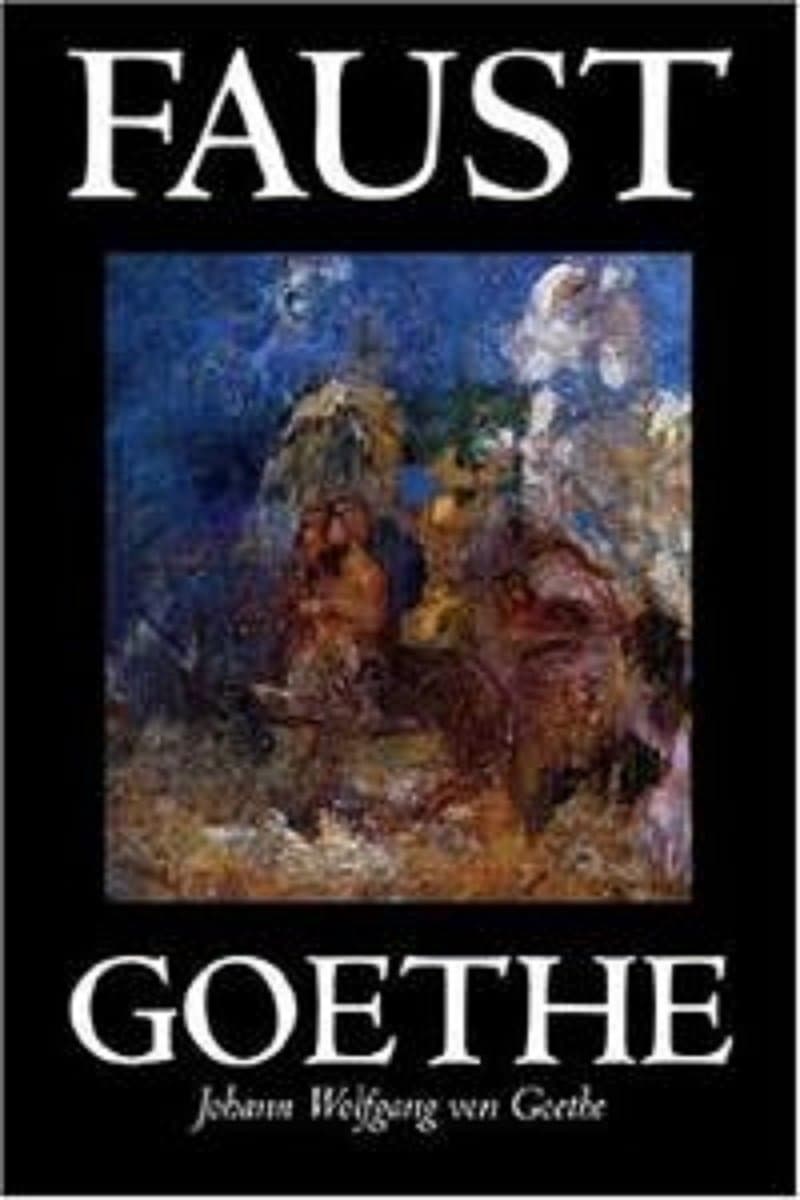
Faust
“Two souls, alas, are housed within my breast, and each will wrestle for the mastery there.”
Faust Summary
An aging scholar named Heinrich Faust has mastered every field of human knowledge and found it all worthless. In despair, he makes a wager with Mephistopheles, the devil: if the devil can show him a single moment so perfect that he wishes it to last forever, Faust will surrender his soul. What follows is a journey through the full spectrum of human experience—seduction, destruction, political power, classical beauty, and visionary ambition—as Faust seeks the one thing his intellect cannot provide: meaning.
Goethe's dramatic poem, composed over sixty years in two parts, is the supreme achievement of German literature. Part One is an intimate tragedy of desire and guilt, centered on Faust's seduction and abandonment of the innocent Gretchen. Part Two is a vast allegorical pageant that ranges from the Emperor's court to the underworld of classical mythology. Together, they form a meditation on the human condition that is as encompassing as anything in Western literature.
Why Read Faust?
Faust is the foundational myth of the modern age. The 'Faustian bargain'—trading one's soul for knowledge, power, or pleasure—has become one of the defining metaphors of Western civilization, and Goethe's version is the definitive telling. It is the story of humanity's restless, insatiable striving: our refusal to accept limits, our willingness to destroy what we love in pursuit of what we desire, and the question of whether that striving can ever be redeemed.
Goethe poured his entire life into this work—his science, his politics, his love affairs, his philosophy—and the result is a text of almost inexhaustible richness. Part One alone contains some of the most powerful scenes in all of drama: Faust's midnight despair, the intoxication of the Walpurgis Night, and the shattering fate of Gretchen. It is a work that demands to be read more than once, and each reading reveals new depths.
About Johann Wolfgang von Goethe
Johann Wolfgang von Goethe (1749–1832) was the towering genius of German culture—poet, novelist, dramatist, scientist, statesman, and philosopher. His early novel The Sorrows of Young Werther made him the most famous writer in Europe at twenty-five, and he spent the remaining six decades of his life producing an astonishing body of work that encompassed virtually every field of human endeavor.
As chief minister of the Duchy of Weimar, he ran mines, built roads, and directed a theater. As a scientist, he developed an influential theory of color. As a writer, he created works—Faust, Wilhelm Meister, the Roman Elegies, the West-Eastern Divan—that defined German Romanticism and transcended it. Napoleon reportedly told him, 'You are a man!' Goethe is the last figure in Western culture who could plausibly be called a universal genius.
Reading Guide
Ranked #91 among the greatest books of all time, Faust by Johann Wolfgang von Goethe has earned its place in the literary canon. Originally written in German and published in 1808–1832, this challenging read from Germany continues to resonate with readers today.
This book belongs to our Philosophy & Faith and Gothic & Dark collections, where you can discover more books that share its spirit and themes.
If you enjoy challenging reads like this one, you might also like Ulysses, Moby-Dick, or Lolita.
From the Philosophy & Faith Collection
If you enjoyed Faust, discover more masterpieces that share its spirit.
 #11View Book
Crime and Punishment
Fyodor Dostoevsky
High•20-25 hours #18View Book
The Bible
Various
Variable•60-80 hours #19View Book
The Brothers Karamazov
Fyodor Dostoevsky
Very High•35-40 hours #21View Book
The Stranger
Albert Camus
Moderate•3-4 hours
Browse more collections