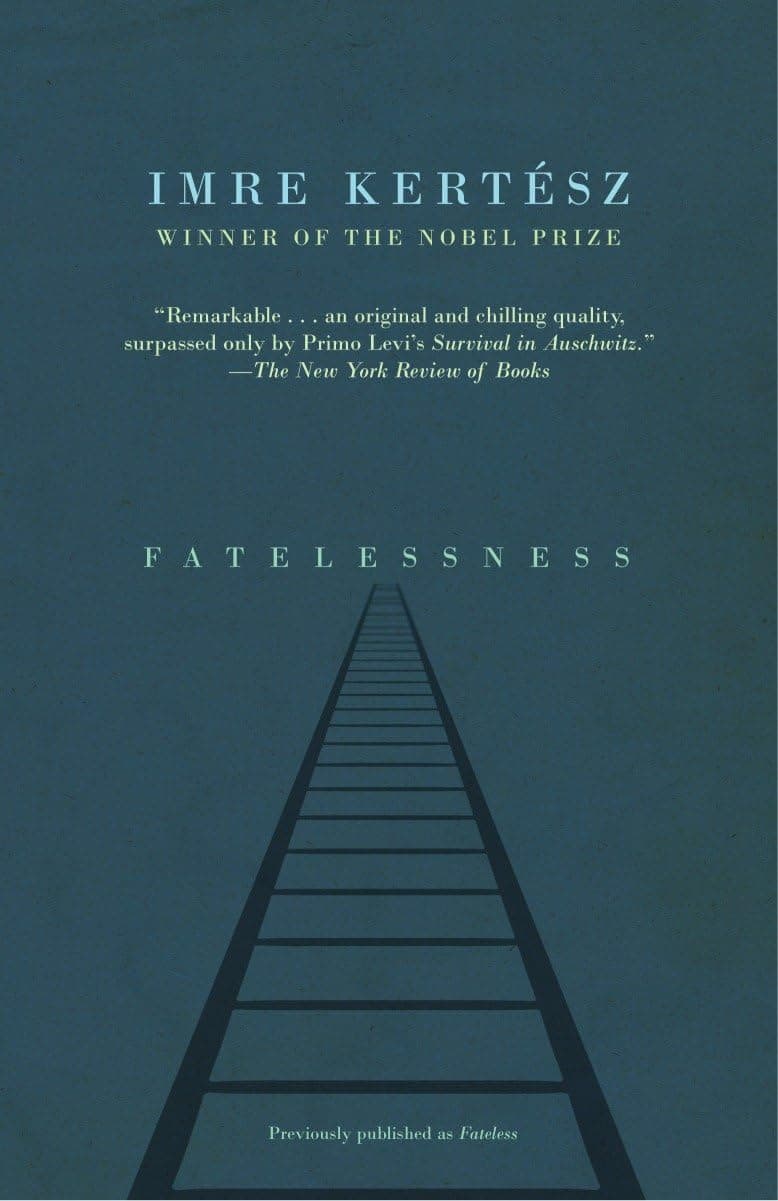
Fatelessness
“I am here, and I know full well that I shall accept any rationale as the price for being able to live.”
Fatelessness Summary
Fatelessness follows fourteen-year-old Gyorgy Koves, a Jewish boy in Budapest, as he is swept up in the machinery of the Holocaust. One ordinary day, on his way to work at a factory, Gyorgy is pulled off a bus by Hungarian gendarmes and deported first to Auschwitz and then to Buchenwald and Zeitz. What makes Kertesz's novel so unsettling and so revolutionary is its narrative perspective: Gyorgy does not narrate his experience with retrospective horror or moral outrage. Instead, he describes each step of his degradation with the naive, almost detached curiosity of an adolescent trying to make sense of a world that operates according to rules he cannot yet comprehend. He finds moments of unexpected pleasure amid the horror, adapts to the routines of camp life, and even discovers a strange contentment in the predictability of suffering.
Kertesz's achievement in Fatelessness is the demolition of every conventional narrative framework for understanding the Holocaust. By refusing to grant his narrator the benefit of hindsight, moral clarity, or even consistent suffering, Kertesz captures something that most Holocaust literature cannot: the lived experience of catastrophe as it unfolds in real time, step by step, each step appearing to follow logically from the last. The novel's most radical argument is embedded in its title: Gyorgy's fate is not his own but has been imposed upon him by a system so totalizing that it subsumes individual destiny entirely. Yet the book is not nihilistic. In its final pages, Gyorgy insists on the reality of his experience and his right to claim it as his own, a defiant assertion of selfhood against the machinery of annihilation. Fatelessness stands as one of the essential literary testimonies of the twentieth century, a work that earned Kertesz the Nobel Prize in Literature in 2002.
Why Read Fatelessness?
If you believe that literature's highest purpose is to make you see the world through eyes radically different from your own, Fatelessness is an essential experience. Kertesz does not offer you the comfort of a redemptive narrative or the catharsis of moral outrage. Instead, he places you inside the consciousness of a boy who experiences the Holocaust not as a grand historical tragedy but as a bewildering series of daily events, each one leading inexorably to the next. This perspective is profoundly disorienting, and that disorientation is precisely the point. You will finish this book understanding something about the nature of totalitarian evil that no history book or conventional memoir can convey.
You should read Fatelessness because it represents a form of literary courage that is extraordinarily rare. Kertesz, himself a Holocaust survivor who was deported to Auschwitz at age fourteen, spent over a decade crafting a novel that refuses every easy consolation. The book challenges you to sit with the uncomfortable truth that human beings can adapt to almost anything, that horror becomes routine, and that the line between victim and collaborator is blurred by the sheer mechanics of survival. It is not an easy read, but it is a necessary one, a work that expands your understanding of what human beings are capable of enduring and what literature is capable of expressing.
About Imre Kertész
Imre Kertesz was born in 1929 in Budapest to a middle-class Jewish family. At the age of fourteen, he was deported to Auschwitz and subsequently transferred to Buchenwald and its subcamp Zeitz, where he was liberated in 1945. Returning to Budapest, he worked briefly as a journalist before the Communist regime's cultural strictures pushed him toward literary translation and freelance writing. He spent over a decade writing Fatelessness, drawing on his own experiences but transforming them into something far more complex than memoir. The novel was published in 1975 to near-complete silence in Communist Hungary, where its refusal to frame the Holocaust in politically useful terms made it unwelcome.
Kertesz continued to write through decades of obscurity, producing novels, essays, and philosophical meditations that collectively form one of the most searching examinations of the Holocaust and totalitarianism in world literature. His international breakthrough came when Fatelessness was translated into German in the 1990s, and in 2002 he was awarded the Nobel Prize in Literature for writing that upholds the fragile experience of the individual against the barbaric arbitrariness of history. The Nobel committee praised his work for its unflinching honesty and its refusal to offer false comfort. Kertesz spent his final years in Budapest and Berlin, continuing to write about memory, identity, and survival until his death in 2016. His legacy is that of a writer who insisted on the primacy of individual experience against systems designed to obliterate it.
Reading Guide
Ranked #457 among the greatest books of all time, Fatelessness by Imre Kertész has earned its place in the literary canon. Originally written in Hungarian and published in 1975, this challenging read from Hungary continues to resonate with readers today.
This book belongs to our Modern Mind collection, where you can discover more books that share its spirit and themes.
If you enjoy challenging reads like this one, you might also like Ulysses, Moby-Dick, or Lolita.
From the Modern Mind Collection
If you enjoyed Fatelessness, discover more masterpieces that share its spirit.
 #1View Book
Ulysses
James Joyce
Challenging•35-40 hours #2View Book
In Search of Lost Time
Marcel Proust
High•100+ hours #8View Book
The Sound and the Fury
William Faulkner
Very High•12-15 hours #13View Book
Lolita
Vladimir Nabokov
Challenging•12-15 hours
Browse more collections