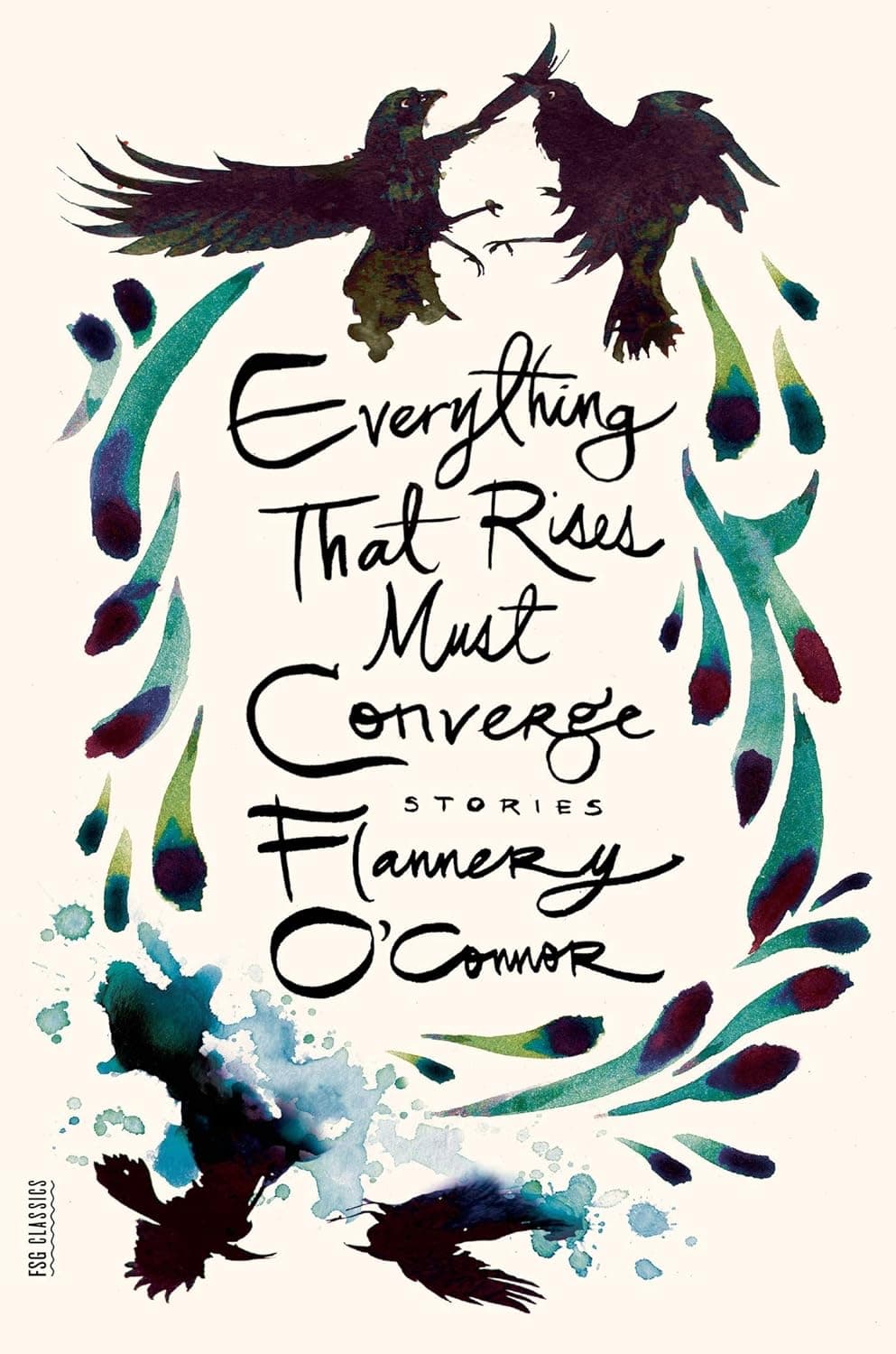
Everything That Rises Must Converge
“She would of been a good woman if it had been somebody there to shoot her every minute of her life.”
Everything That Rises Must Converge Summary
Published posthumously, this collection of nine stories represents the final flowering of Flannery O'Connor's fierce, darkly comic vision. The title story follows Julian, a smug young liberal, and his aging mother as they ride a newly integrated bus in the American South, a journey that ends in a shattering act of violence that strips away Julian's self-righteousness and leaves him utterly exposed. Across the collection, O'Connor returns obsessively to the collision between the old South and the new: a woman's prize bull gores her to death in a moment of terrible grace; a Bible salesman steals a woman's wooden leg; a child drowns during his own baptism. Each story moves with the coiled inevitability of a parable toward a moment of crisis in which her characters are offered the possibility of divine revelation, whether they accept it or not.
O'Connor's stories are among the most powerful in the American canon, combining the grotesque humor of Southern Gothic with the theological seriousness of a devout Catholic imagination. Her characters are vain, self-deceived, and often monstrous, yet she treats them with a compassion that arises from her belief that even the most debased soul is capable of encountering grace. The violence in her fiction is never gratuitous; it is the mechanism by which the complacent are jolted into spiritual awareness. This collection, completed as O'Connor battled the lupus that would kill her at thirty-nine, possesses a concentrated intensity that marks it as the work of a writer who understood that every word might be her last.
Why Read Everything That Rises Must Converge?
Flannery O'Connor's stories will ambush you. They begin with scenarios that seem darkly comic, even absurd, and then veer without warning into moments of such devastating truth that you will find yourself gasping. Her characters are people you recognize instantly: the self-satisfied intellectual, the controlling mother, the smiling hypocrite. She strips away their defenses with surgical precision, exposing the pride and self-deception that lurk beneath polite Southern manners. No writer in American literature is more skilled at revealing the gap between who we think we are and who we actually are.
What makes O'Connor indispensable is her ability to hold comedy and tragedy, the sacred and the profane, in perfect tension. You will laugh at her characters even as you pity them. You will recoil from the violence even as you recognize its necessity within her moral vision. These stories demand to be read and reread, because each encounter reveals new layers of meaning. If you want to understand the American South, the mystery of grace, or simply the art of the short story at its highest pitch, this collection is essential.
About Flannery O'Connor
Mary Flannery O'Connor (1925-1964) was born in Savannah, Georgia, and raised in the devoutly Catholic household that would shape her literary imagination. She studied at the Georgia State College for Women and the Iowa Writers' Workshop, where she began crafting the distinctive stories that would make her reputation. In 1950, she was diagnosed with lupus, the same autoimmune disease that had killed her father, and she returned to her mother's dairy farm in Milledgeville, Georgia, where she lived for the remaining fourteen years of her life, writing, raising peacocks, and corresponding with a wide circle of friends and fellow writers.
Despite her brief career, O'Connor is universally regarded as one of the greatest American short story writers. Her two novels, Wise Blood and The Violent Bear It Away, and two story collections represent a body of work of extraordinary density and power. Her fusion of Southern Gothic sensibility with Catholic theological vision created a literary voice unlike any other, one that influenced generations of writers from Raymond Carver to Toni Morrison. Her letters, collected in The Habit of Being, reveal a mind of remarkable wit, clarity, and spiritual depth.
Reading Guide
Ranked #485 among the greatest books of all time, Everything That Rises Must Converge by Flannery O'Connor has earned its place in the literary canon. Originally written in English and published in 1965, this moderate read from United States continues to resonate with readers today.
This book belongs to our Gothic & Dark and American Spirit collections, where you can discover more books that share its spirit and themes.
If you enjoy moderate reads like this one, you might also like One Hundred Years of Solitude, Nineteen Eighty-Four, or Wuthering Heights.
From the Gothic & Dark Collection
If you enjoyed Everything That Rises Must Converge, discover more masterpieces that share its spirit.
 #15View Book
Wuthering Heights
Emily Brontë
Moderate•10-12 hours #29View Book
Jane Eyre
Charlotte Brontë
Accessible•15-20 hours #41View Book
Frankenstein
Mary Shelley
Accessible•6-8 hours #44View Book
Absalom, Absalom!
William Faulkner
Very High•12-15 hours
Browse more collections