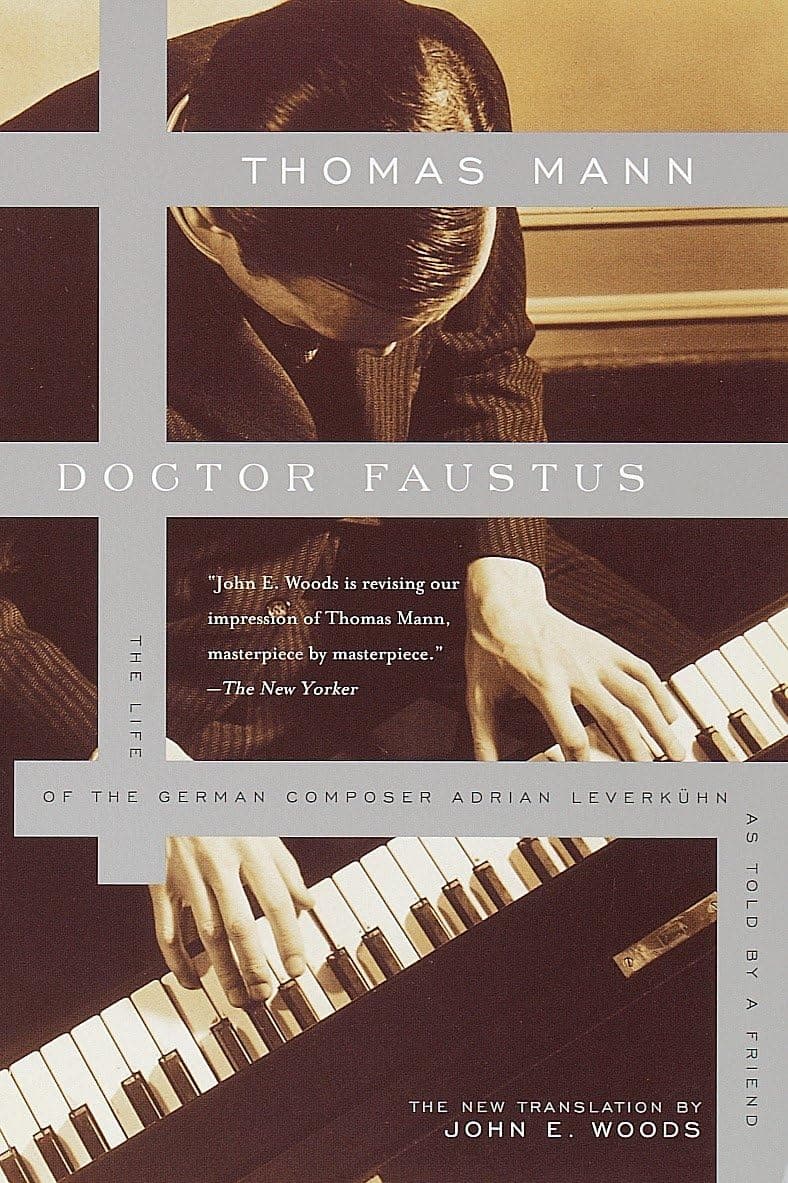
Doctor Faustus
“For the sake of goodness and love, man shall grant death no dominion over his thoughts.”
Doctor Faustus Summary
Serenus Zeitblom, a retired classics teacher, sits down in 1943 to write the biography of his childhood friend Adrian Leverkuhn, a composer of genius who may have made a pact with the devil. The story follows Leverkuhn from his provincial upbringing through his studies in theology and music to his creation of a revolutionary twelve-tone composition that shatters the boundaries of art. But the price of his genius is total—a deliberately contracted syphilitic infection that fuels his creativity while slowly destroying his mind.
Mann's last great novel is a devastating allegory of Germany's own Faustian bargain. As Zeitblom narrates his friend's ascent and collapse, the Third Reich rises and falls around him. The parallels are unmistakable: a nation that sold its soul for greatness and reaped annihilation. Mann weaves together music theory, theology, philosophy, and the Faust legend into a dense, polyphonic masterwork that is at once a portrait of artistic genius, a lament for German culture, and a reckoning with the catastrophe of the twentieth century.
Why Read Doctor Faustus?
Doctor Faustus is Thomas Mann's most ambitious and most anguished novel—his attempt to understand how the nation of Goethe, Beethoven, and Bach could have descended into barbarism. The answer he offers is terrifying: that the very qualities that made German culture great—its depth, its inwardness, its willingness to push beyond all boundaries—contained the seeds of its destruction. Genius and madness, creation and annihilation, are separated by the thinnest of membranes.
The novel demands patience and rewards it tenfold. Mann's prose is intricate, his musical analysis precise and genuinely illuminating, and the slow unraveling of Leverkuhn's mind is rendered with heartbreaking tenderness by the narrator who loved him. Doctor Faustus is not a novel you read quickly; it is a novel you live inside. For anyone who has ever wondered how beauty and evil can coexist in the same civilization, this is the essential text.
About Thomas Mann
Thomas Mann (1875–1955) was awarded the Nobel Prize in Literature in 1929 and is widely regarded as the greatest German novelist of the twentieth century. From Buddenbrooks to The Magic Mountain to Doctor Faustus, his work charted the decline of bourgeois European civilization with magisterial irony and psychological depth.
Mann fled Nazi Germany in 1933 and spent the war years in American exile, broadcasting anti-Nazi addresses to the German people via the BBC. Doctor Faustus, written during these years of exile, was his most personal and painful work—a reckoning with the culture he loved and the catastrophe it had produced. He remains the supreme chronicler of the tensions between art and life, intellect and emotion, order and chaos.
Reading Guide
Ranked #123 among the greatest books of all time, Doctor Faustus by Thomas Mann has earned its place in the literary canon. Originally written in German and published in 1947, this very high read from Germany continues to resonate with readers today.
This book belongs to our Modern Mind and Gothic & Dark collections, where you can discover more books that share its spirit and themes.
If you enjoy very high reads like this one, you might also like The Sound and the Fury, War and Peace, or The Brothers Karamazov.
From the Modern Mind Collection
If you enjoyed Doctor Faustus, discover more masterpieces that share its spirit.
 #1View Book
Ulysses
James Joyce
Challenging•35-40 hours #2View Book
In Search of Lost Time
Marcel Proust
High•100+ hours #8View Book
The Sound and the Fury
William Faulkner
Very High•12-15 hours #13View Book
Lolita
Vladimir Nabokov
Challenging•12-15 hours
Browse more collections