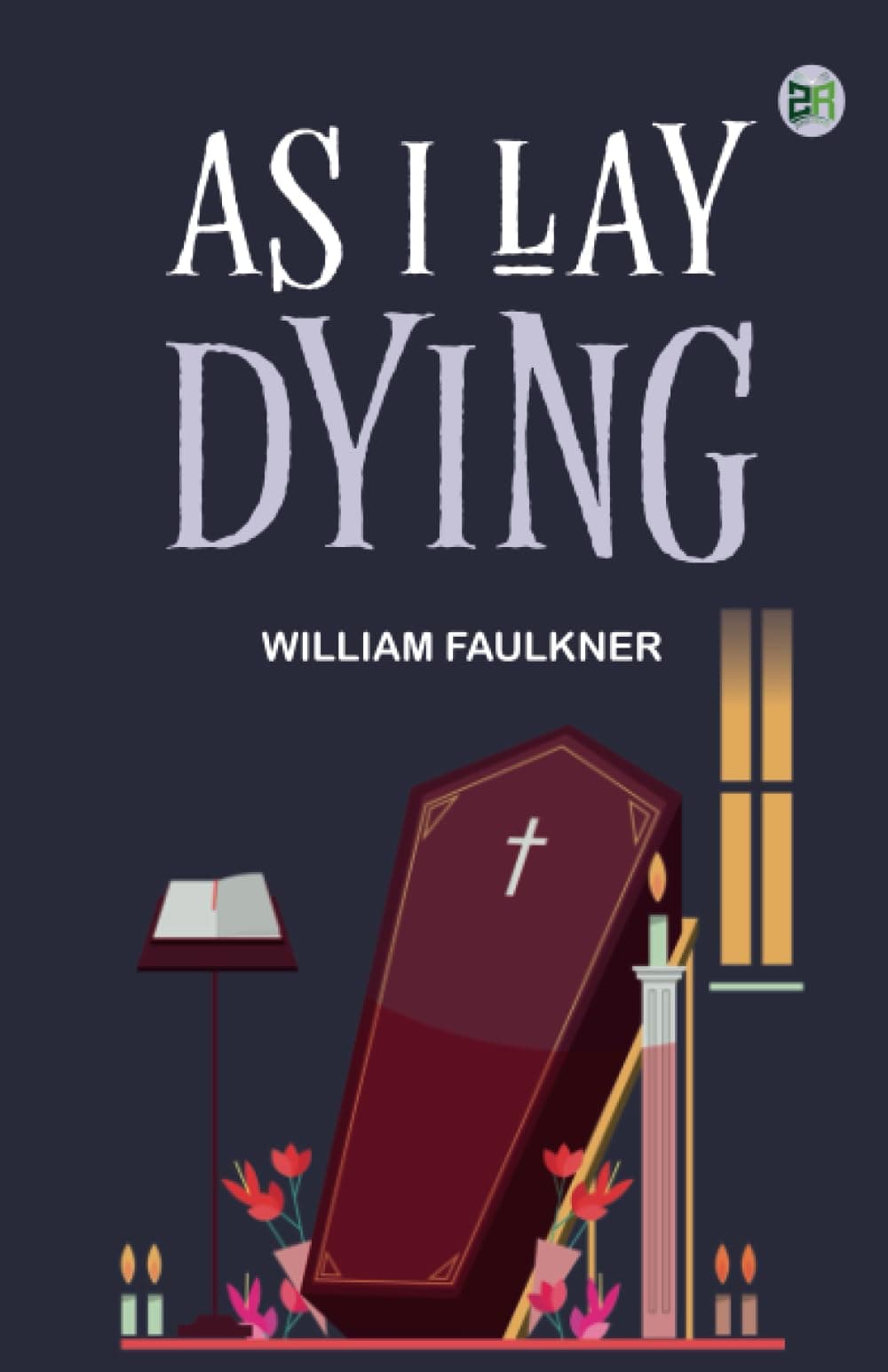
As I Lay Dying
“My mother is a fish.”
As I Lay Dying Summary
Addie Bundren is dying in a farmhouse in rural Mississippi, and she has extracted a promise from her husband Anse: when she dies, he will carry her body to Jefferson, forty miles away, to be buried with her own people. What follows is a grotesque, darkly comic odyssey. The Bundren family loads Addie's corpse onto a wagon and sets out across a landscape of flooded rivers, burning barns, and circling buzzards. Each family member narrates a portion of the journey, and each has a secret motive for making the trip—Anse wants new teeth, Dewey Dell needs an abortion, Cash wants a gramophone, and Vardaman, the youngest, believes his mother is a fish.
Faulkner claimed he wrote the novel in six weeks while working the night shift at a power plant, and the book crackles with that white-hot intensity. Through fifteen narrators—including the dead Addie herself—he constructs a polyphonic portrait of a family that is simultaneously heroic and absurd, loyal and selfish, bound together and utterly alone.
Why Read As I Lay Dying?
As I Lay Dying is Faulkner at his most accessible and his most audacious. The novel's structure—fifty-nine short chapters narrated by fifteen different voices—sounds experimental, but it reads with the momentum of a freight train. Each narrator has a distinctive rhythm: Cash's carpenter's precision, Darl's haunted lyricism, Vardaman's childish confusion, Addie's bitter posthumous monologue. Together, they create a symphony of grief, denial, and dark humor.
Beneath the black comedy is a devastating exploration of what holds a family together and what tears it apart. The Bundrens are poor, stubborn, and magnificently alive—and their absurd pilgrimage with a rotting corpse becomes, against all odds, a story about love, duty, and the lengths people will go to keep a promise. It is one of the great American novels, and at barely two hundred pages, it proves that Faulkner could be as ruthlessly economical as he was expansive.
About William Faulkner
William Faulkner (1897–1962) was the titan of Southern American literature, a Nobel Prize laureate who created an entire fictional world—Yoknapatawpha County, Mississippi—and populated it with some of the most memorable characters in fiction. In a remarkable burst of creativity between 1929 and 1936, he produced The Sound and the Fury, As I Lay Dying, Light in August, and Absalom, Absalom!—a run of masterpieces virtually unmatched in American letters.
Faulkner worked as a screenwriter in Hollywood to pay the bills, contributed to films including The Big Sleep and To Have and Have Not, and struggled with alcoholism throughout his life. He received the Nobel Prize in 1949 and delivered one of the most famous acceptance speeches in history, affirming his belief that humanity would not merely endure but prevail.
Reading Guide
Ranked #82 among the greatest books of all time, As I Lay Dying by William Faulkner has earned its place in the literary canon. Originally written in English and published in 1930, this challenging read from United States continues to resonate with readers today.
This book belongs to our American Spirit and Modern Mind collections, where you can discover more books that share its spirit and themes.
If you enjoy challenging reads like this one, you might also like Ulysses, Moby-Dick, or Lolita.
From the American Spirit Collection
If you enjoyed As I Lay Dying, discover more masterpieces that share its spirit.
 #3View Book
The Great Gatsby
F. Scott Fitzgerald
Accessible•5-6 hours #4View Book
The Catcher in the Rye
J. D. Salinger
Accessible•6-8 hours #13View Book
Lolita
Vladimir Nabokov
Challenging•12-15 hours #17View Book
To Kill a Mockingbird
Harper Lee
Accessible•8-10 hours
Browse more collections