V
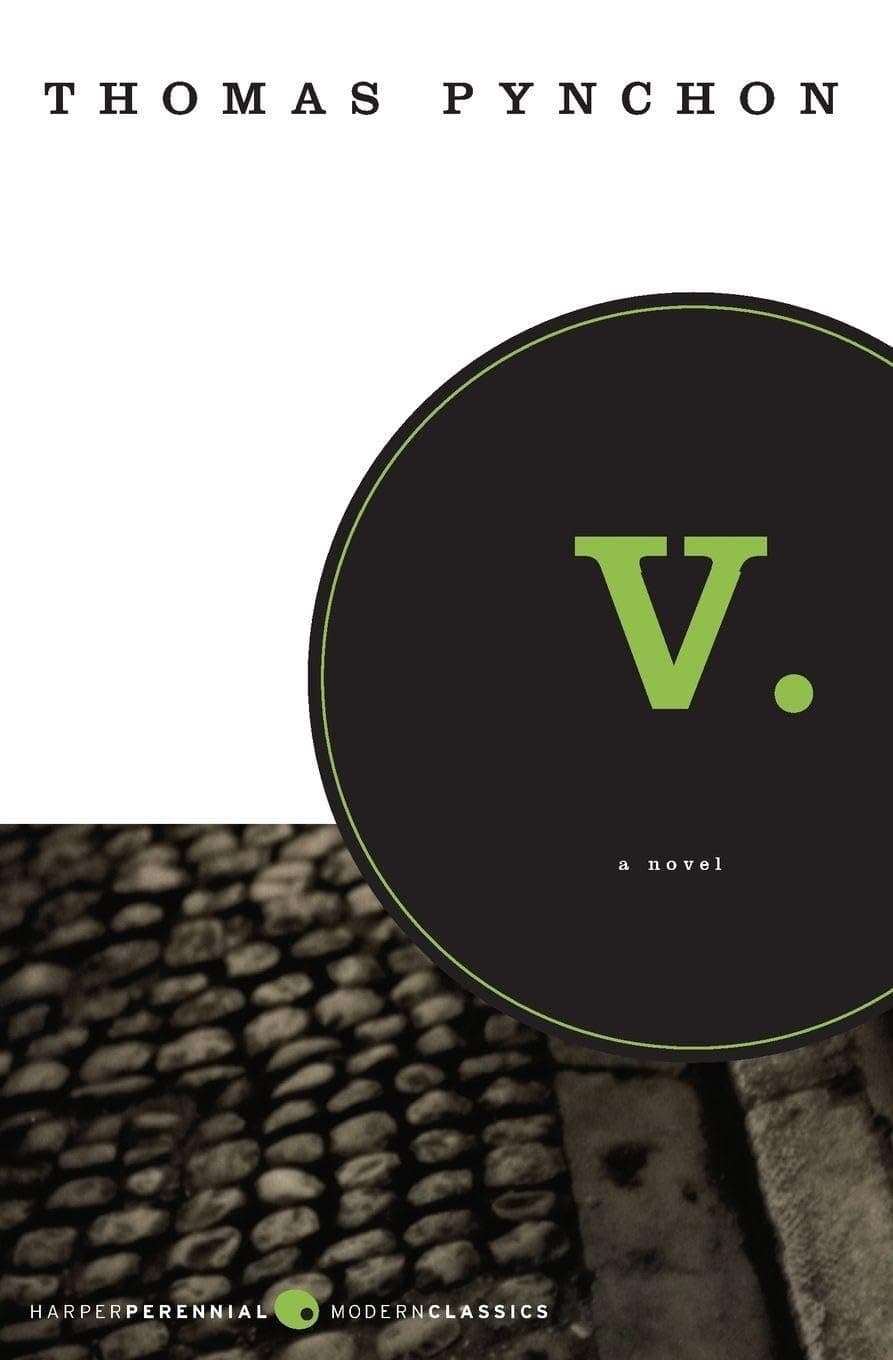
“Keep cool but care.”
V Summary
Thomas Pynchon's sprawling debut novel oscillates between two narrative threads that seem perpetually on the verge of convergence. In 1950s New York, Benny Profane, an amiable schlemihl and self-described human yo-yo, drifts through a picaresque existence among the Whole Sick Crew, a collection of artists, bohemians, and party-goers whose lives are defined by aimlessness and entropy. Meanwhile, Herbert Stencil, son of a deceased British intelligence agent, obsessively pursues the mysterious figure or entity known only as V., whose appearances thread through the great catastrophes of the twentieth century: colonial violence in German South-West Africa, espionage in pre-World War I Florence, the siege of Malta during World War II, and uprisings in 1950s Egypt. V. manifests variously as a woman, a city, a concept, perhaps even the shape of history itself, growing progressively more inorganic and mechanical with each incarnation. The chapters alternate between Profane's street-level wanderings and Stencil's historical reconstructions, creating a dizzying mosaic of paranoia, dark comedy, and geopolitical horror.
V. announced the arrival of one of the most formidable imaginations in American literature. Pynchon's encyclopedic ambition, his ability to move between slapstick comedy and genuine horror, his fascination with entropy, conspiracy, and the intersection of human agency and historical forces, all emerged fully formed in this debut. The novel resists summary because it resists coherence by design, enacting through its very structure the impossibility of imposing a single narrative on the chaos of the modern world. V. is a novel about the search for meaning in an age that may have rendered meaning obsolete, and its influence on postmodern fiction has been immeasurable.
Why Read V?
V. is one of those books that rewires how you think about fiction. Pynchon's debut throws you into a world where slapstick comedy and colonial atrocity coexist on the same page, where a hunt for alligators in the New York sewer system carries the same narrative weight as the Herero genocide in South-West Africa. The experience of reading it is disorienting, exhilarating, and frequently hilarious, a rollercoaster through the wreckage of the twentieth century piloted by an imagination that seems to contain entire libraries. You will encounter sentences and scenes that lodge permanently in your memory.
If you have any interest in understanding postmodern fiction, V. is where it crystallizes into something genuinely new. But you do not need to care about literary movements to be captivated by this novel. Its central questions, whether history has a pattern or is merely chaos, whether we project meaning onto the world or discover it there, whether human beings are becoming more like the machines they create, remain as urgent as they were in 1963. This is a challenging book, but it rewards persistence with passages of extraordinary beauty and wit that few novels can match.
About Thomas Pynchon
Thomas Pynchon was born in 1937 in Glen Cove, New York. He studied engineering physics at Cornell University, where he took a creative writing class with Vladimir Nabokov, and served briefly in the United States Navy before beginning his literary career. After the publication of V. in 1963, which won the William Faulkner Foundation Award for best first novel, Pynchon retreated almost entirely from public life and has maintained his privacy with legendary determination ever since.
Pynchon is widely regarded as one of the greatest American novelists of the twentieth century. His masterwork, Gravity's Rainbow, published in 1973, won the National Book Award and is considered one of the landmark novels of the postmodern era. His other major works include The Crying of Lot 49, Mason & Dixon, Against the Day, and Inherent Vice. Pynchon's fiction is characterized by its encyclopedic scope, its integration of science, history, and popular culture, its dark comedy, and its profound engagement with questions of power, paranoia, and entropy. No photograph of Pynchon has been published since the 1950s, making him perhaps the most famous recluse in American letters.
Reading Guide
Ranked #438 among the greatest books of all time, V by Thomas Pynchon has earned its place in the literary canon. Originally written in English and published in 1963, this very high read from United States continues to resonate with readers today.
This book belongs to our Modern Mind and American Spirit collections, where you can discover more books that share its spirit and themes.
If you enjoy very high reads like this one, you might also like The Sound and the Fury, War and Peace, or The Brothers Karamazov.
From the Modern Mind Collection
If you enjoyed V, discover more masterpieces that share its spirit.
 #1View Book
Ulysses
James Joyce
Challenging•35-40 hours #2View Book
In Search of Lost Time
Marcel Proust
High•100+ hours #8View Book
The Sound and the Fury
William Faulkner
Very High•12-15 hours #13View Book
Lolita
Vladimir Nabokov
Challenging•12-15 hours
Browse more collections