Tristes Tropiques
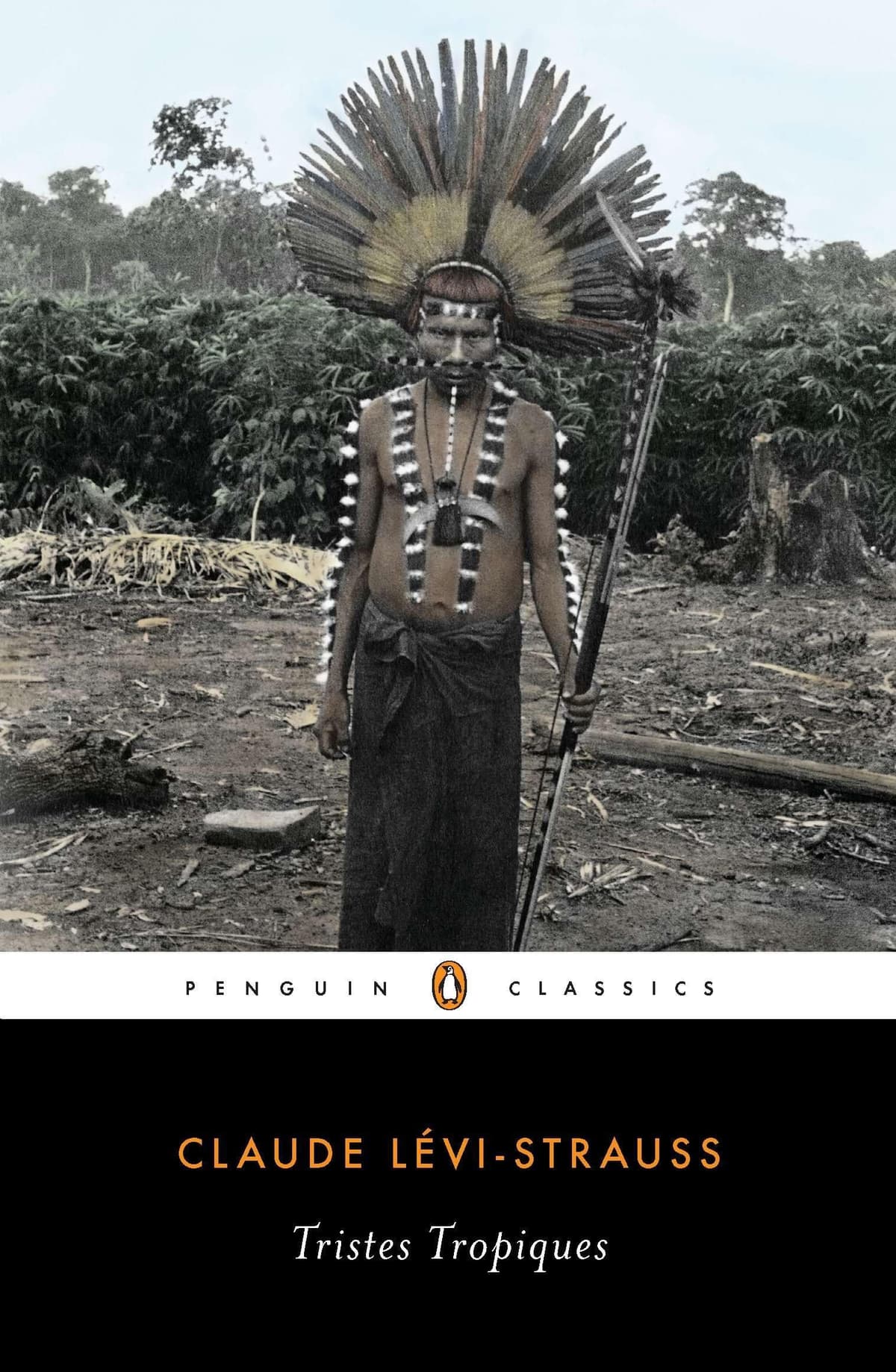
“The world began without man, and it will complete itself without him.”
Tristes Tropiques Summary
Tristes Tropiques defies easy categorization, blending autobiography, philosophy, travelogue, and anthropological reflection into a singular meditation on civilization, nature, and the nature of human understanding. Claude Lévi-Strauss begins with the famous declaration that he hates travel and explorers, then proceeds to recount his journeys through the interior of Brazil in the 1930s, where as a young professor he encountered indigenous peoples including the Caduveo, Bororo, Nambikwara, and Tupi-Kawahib. His descriptions of these encounters are vivid and deeply respectful, portraying cultures of extraordinary complexity and beauty that were already being destroyed by the advancing frontier of Western civilization. Yet the book is far more than ethnographic reportage: it moves freely between Lévi-Strauss's memories of growing up in France, his philosophical reflections on the nature of travel and knowledge, his observations on Indian and Islamic civilizations encountered on the way to and from Brazil, and extended meditations on the relationship between nature and culture that would become the foundation of structural anthropology.
Triste Tropiques is one of the great intellectual autobiographies of the twentieth century, a work that transforms the genre of travel writing by subjecting it to rigorous philosophical scrutiny. Lévi-Strauss asks what it means to encounter another culture, whether genuine understanding across cultural boundaries is possible, and what the destruction of indigenous peoples reveals about the civilization that destroys them. His famous analysis of the Nambikwara writing lesson questions Western assumptions about literacy and progress, while his closing meditation on entropy and the eventual dissolution of all human achievement gives the book a melancholy grandeur. The prose, even in translation, achieves a rare combination of intellectual precision and lyric beauty, making Tristes Tropiques essential reading not only for anthropologists but for anyone who grapples with questions of cultural difference, the costs of modernity, and the limits of human knowledge.
Why Read Tristes Tropiques?
If you are interested in how we understand cultures different from our own and what that understanding reveals about the limits of our own civilization, Tristes Tropiques is indispensable. Lévi-Strauss writes with a literary grace rare among scientists, and his book moves between the personal and the philosophical with a fluency that makes complex ideas accessible and urgent. You will travel with him into the Brazilian interior, encounter peoples whose ways of life challenge every Western assumption, and be drawn into meditations on the nature of knowledge itself that are as relevant today as when they were written. This is a book that expands the boundaries of how you think about human culture and your place within it.
Beyond its intellectual content, Tristes Tropiques rewards you as a work of art. Lévi-Strauss's descriptions of landscapes, people, and ideas possess a beauty that transcends their analytical purpose, and his autobiographical passages reveal a sensibility shaped by deep engagement with music, geology, and philosophy. Reading this book connects you to one of the most influential thinkers of the twentieth century at the moment when his ideas were taking shape, offering you insight into both the method and the temperament behind structural anthropology. It is one of those rare works that changes not just what you think but how you think.
About Claude Lévi-Strauss
Claude Lévi-Strauss was born in 1908 in Brussels, Belgium, and grew up in Paris in a cultured family of Alsatian Jewish descent. He studied law and philosophy at the Sorbonne, where he passed the agrégation in philosophy. Dissatisfied with academic philosophy, he accepted a position teaching sociology at the University of São Paulo in Brazil in 1935, which led to the fieldwork expeditions among indigenous peoples of the Mato Grosso and the Amazon that would transform his intellectual life. He fled France during World War II and spent the war years in New York, where his encounters with Roman Jakobson and structural linguistics proved decisive for his intellectual development. After the war, he returned to Paris and produced the works that established structural anthropology as a major intellectual movement, including The Elementary Structures of Kinship, Structural Anthropology, The Savage Mind, and the four-volume Mythologiques.
Lévi-Strauss is recognized as one of the most important intellectuals of the twentieth century and the founder of structural anthropology. His work demonstrated that the supposedly "primitive" thought of indigenous peoples operates according to the same logical structures as Western science, fundamentally challenging evolutionary hierarchies of human cognition. His influence extended far beyond anthropology into philosophy, literary criticism, and the broader intellectual movement known as structuralism. He was elected to the Académie française in 1973 and received honors from institutions worldwide. He lived to the age of one hundred, dying in 2009, and his work continues to shape debates about culture, cognition, and the relationship between nature and human meaning-making.
Reading Guide
Ranked #470 among the greatest books of all time, Tristes Tropiques by Claude Lévi-Strauss has earned its place in the literary canon. Originally written in French and published in 1955, this challenging read from France continues to resonate with readers today.
This book belongs to our Philosophy & Faith collection, where you can discover more books that share its spirit and themes.
If you enjoy challenging reads like this one, you might also like Ulysses, Moby-Dick, or Lolita.
From the Philosophy & Faith Collection
If you enjoyed Tristes Tropiques, discover more masterpieces that share its spirit.
 #11View Book
Crime and Punishment
Fyodor Dostoevsky
High•20-25 hours #18View Book
The Bible
Various
Variable•60-80 hours #19View Book
The Brothers Karamazov
Fyodor Dostoevsky
Very High•35-40 hours #21View Book
The Stranger
Albert Camus
Moderate•3-4 hours
Browse more collections