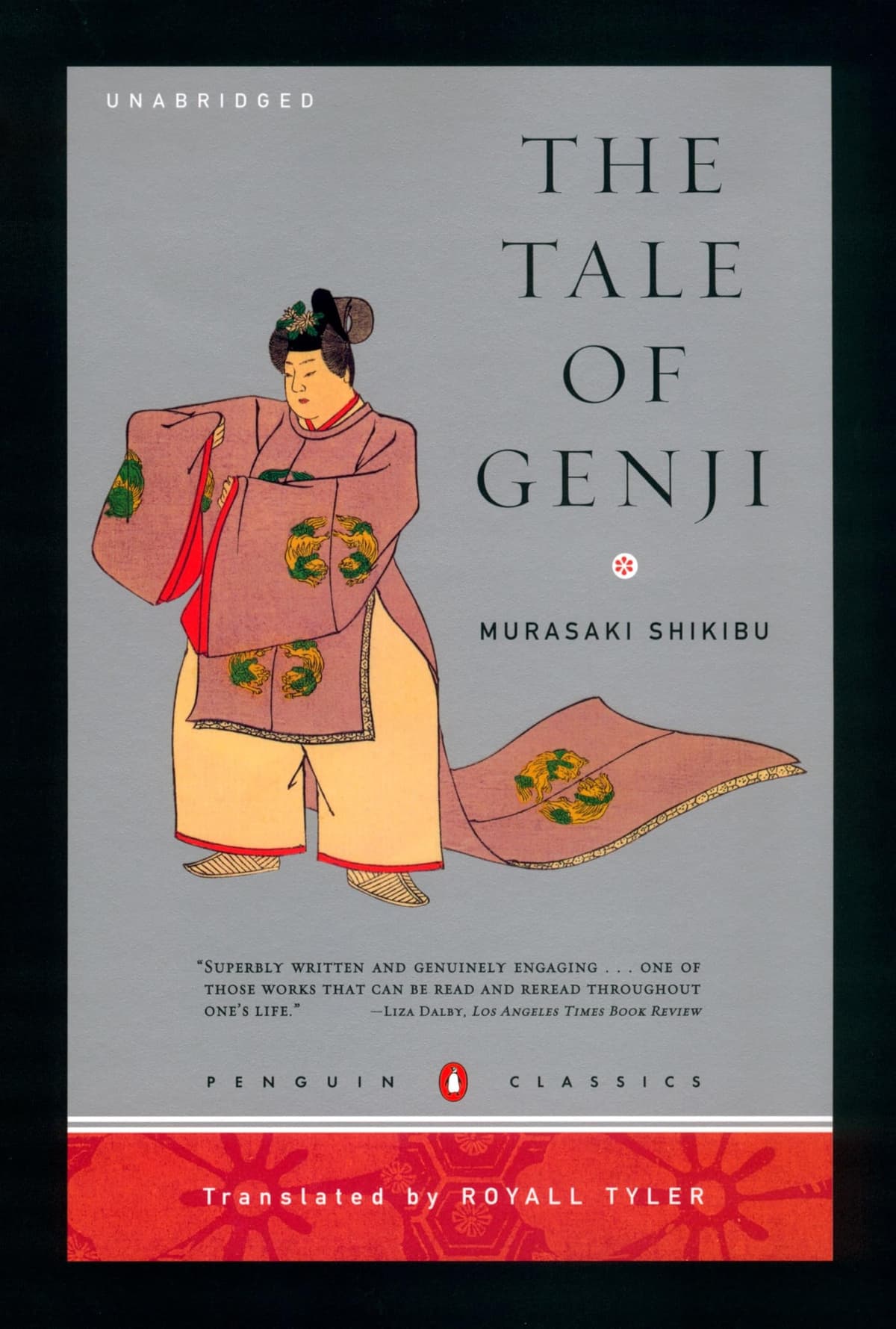
The Tale of Genji
“No art or learning is to be pursued halfheartedly... and any art worth learning will certainly reward more or less generously the effort made to study it.”
The Tale of Genji Summary
In the jewel-box world of Heian-era Japan, Prince Genji—the Shining One—moves through a lifetime of love affairs, political intrigues, and aesthetic refinements. The illegitimate son of an emperor and a low-ranking consort who dies when he is a child, Genji is dazzlingly beautiful, impossibly talented, and perpetually restless. His romantic entanglements—with his father's young wife, with a girl he adopts and later marries, with women of every rank and temperament—form the emotional spine of a novel that spans decades and generations.
But to call The Tale of Genji a romance is to miss its depth. Murasaki Shikibu created a world of exquisite surface beauty—moonlit gardens, silk robes layered in precise chromatic harmonies, poems exchanged as courtship—beneath which lies an unflinching awareness of impermanence, jealousy, and sorrow. The novel's second half, written after Genji's death, follows a new generation into ever-deepening melancholy, ending not with resolution but with a woman's silence and a door left open.
Why Read The Tale of Genji?
Written around the year 1000, The Tale of Genji is widely regarded as the world's first novel—and one of the greatest. A thousand years before Proust, Murasaki Shikibu was exploring memory, desire, and the passage of time with a psychological subtlety that remains astonishing. She invented techniques of interiority and narrative ambiguity that Western literature would not discover for another eight centuries.
To read The Tale of Genji is to enter a civilization utterly unlike our own and yet instantly recognizable in its emotional truths. The ache of unrequited love, the terror of aging, the way beauty intensifies the awareness of its own transience—mono no aware, the pathos of things—suffuses every page. It is a book that teaches you to pay attention, to notice the color of a sleeve glimpsed through a curtain, the scent of incense on a letter, the silence after a poem has been spoken. No other novel offers so complete a world.
About Murasaki Shikibu
Murasaki Shikibu (c. 973–c. 1014 or 1025) was a lady-in-waiting at the imperial court of Heian Japan. Born into the Fujiwara clan, she was exceptionally learned in Chinese literature—an unusual and somewhat scandalous accomplishment for a woman of her era—and kept a diary that provides invaluable insights into court life.
Her masterwork, The Tale of Genji, was composed over several years and circulated chapter by chapter among the court ladies. It established the novel as a literary form a millennium ago, influencing the entire tradition of Japanese literature. Murasaki Shikibu is one of the supreme artists of world civilization, and her achievement—creating the novel itself—has no parallel in literary history.
Reading Guide
Ranked #134 among the greatest books of all time, The Tale of Genji by Murasaki Shikibu has earned its place in the literary canon. Originally written in Classical Japanese and published in c. 1000, this challenging read from Japan continues to resonate with readers today.
This book belongs to our Epics and Love & Loss collections, where you can discover more books that share its spirit and themes.
If you enjoy challenging reads like this one, you might also like Ulysses, Moby-Dick, or Lolita.
From the Epics Collection
If you enjoyed The Tale of Genji, discover more masterpieces that share its spirit.
 #1View Book
Ulysses
James Joyce
Challenging•35-40 hours #5View Book
One Hundred Years of Solitude
Gabriel García Márquez
Moderate•15-20 hours #7View Book
Moby-Dick
Herman Melville
Challenging•20-25 hours #9View Book
Don Quixote
Miguel de Cervantes
High•35-40 hours
Browse more collections