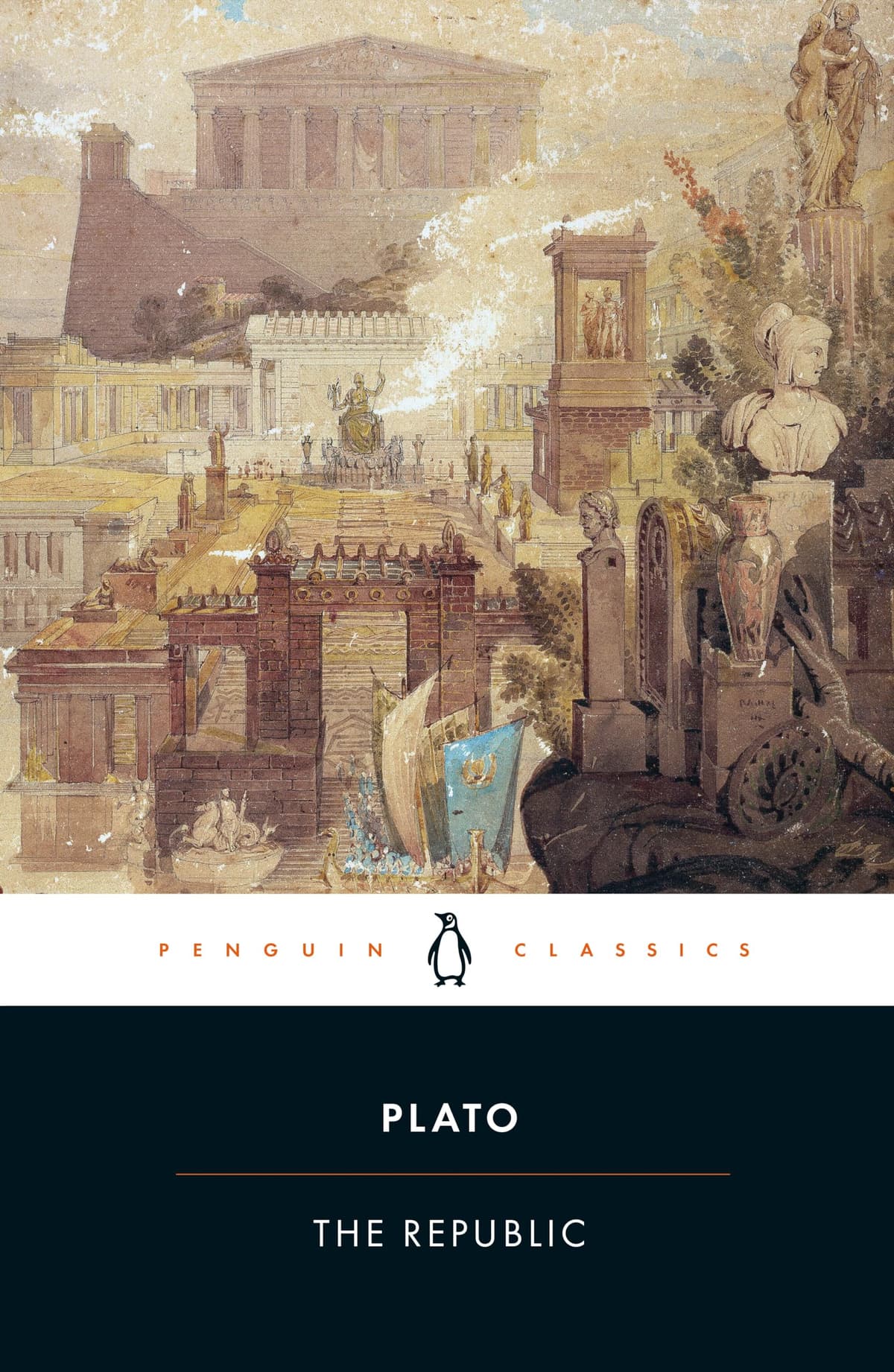
The Republic
“The myth is not mine. I got it from others. But if we believe it, we shall pass safely across the river of Forgetfulness and our soul will not be defiled.”
The Republic Summary
Socrates and a group of Athenians gather at the house of Cephalus in the Piraeus, and a conversation about justice spirals outward into one of the most ambitious intellectual constructions in human history. What begins as a simple question—what is justice, and is the just person happier than the unjust?—becomes a blueprint for an ideal city-state, an exploration of the human soul, a theory of education, a critique of art, and a vision of reality itself that would shape Western thought for two and a half millennia. Along the way, Socrates dispatches the sophist Thrasymachus, who argues that justice is merely the advantage of the stronger, and constructs his famous tripartite model of the soul—reason, spirit, and appetite—mirrored in the structure of the ideal state.
The Republic's most famous passage is the Allegory of the Cave, in which prisoners chained in darkness mistake shadows on the wall for reality, and the philosopher who escapes into the sunlight must return to liberate them. It is an image so powerful that it has become the foundational metaphor of Western philosophy—for enlightenment, for education, for the painful journey from ignorance to knowledge. Plato writes in dialogue form, which gives his philosophy a dramatic life that treatises lack; Socrates is witty, ironic, relentless, and his interlocutors are vivid personalities. The Republic is not a dusty relic—it is a living argument about justice, truth, and the good life that demands the reader's active participation on every page.
Why Read The Republic?
Every argument you have ever had about fairness, truth, education, or the purpose of government has its roots in this book. Plato did not merely ask what justice is—he constructed an entire world to answer the question, and in doing so invented political philosophy, epistemology, and the very idea that reality might be fundamentally different from what our senses tell us. The Allegory of the Cave alone has generated more commentary, art, and debate than most entire libraries.
But The Republic is not merely important—it is genuinely thrilling to read. Socrates is one of literature's great characters: maddening, funny, relentless, and deeply humane. His dialogues are dramas of the mind, full of reversals and surprises, and Plato's prose—even in translation—has a crystalline beauty. You do not have to agree with Plato's conclusions to be transformed by his questions. This is the book that taught the Western world to think, and engaging with it is one of the most rewarding intellectual experiences available to any reader.
About Plato
Plato (c. 428–348 BCE) was born into one of Athens's most distinguished aristocratic families during the golden age of Greek civilization. He became a devoted student of Socrates, whose trial and execution in 399 BCE profoundly shaped his thought and his life's work. After traveling through the Mediterranean—including visits to Sicily that involved him in dangerous political intrigues—he returned to Athens and founded the Academy, the Western world's first institution of higher learning, which would endure for nearly nine centuries.
Plato wrote some thirty dialogues, all featuring Socrates as the principal speaker, covering virtually every area of philosophical inquiry: ethics, politics, metaphysics, epistemology, aesthetics, and the nature of the soul. The Republic, the Symposium, the Phaedo, and the Phaedrus are among the most celebrated works of philosophy ever written. Alfred North Whitehead famously observed that all of Western philosophy is a series of footnotes to Plato—a claim that, while hyperbolic, captures the extraordinary reach of his influence on every subsequent tradition of thought.
Reading Guide
Ranked #213 among the greatest books of all time, The Republic by Plato has earned its place in the literary canon. Originally written in Ancient Greek and published in -379, this challenging read from Greece continues to resonate with readers today.
This book belongs to our Philosophy & Faith collection, where you can discover more books that share its spirit and themes.
If you enjoy challenging reads like this one, you might also like Ulysses, Moby-Dick, or Lolita.
From the Philosophy & Faith Collection
If you enjoyed The Republic, discover more masterpieces that share its spirit.
 #11View Book
Crime and Punishment
Fyodor Dostoevsky
High•20-25 hours #18View Book
The Bible
Various
Variable•60-80 hours #19View Book
The Brothers Karamazov
Fyodor Dostoevsky
Very High•35-40 hours #21View Book
The Stranger
Albert Camus
Moderate•3-4 hours
Browse more collections