Hunger
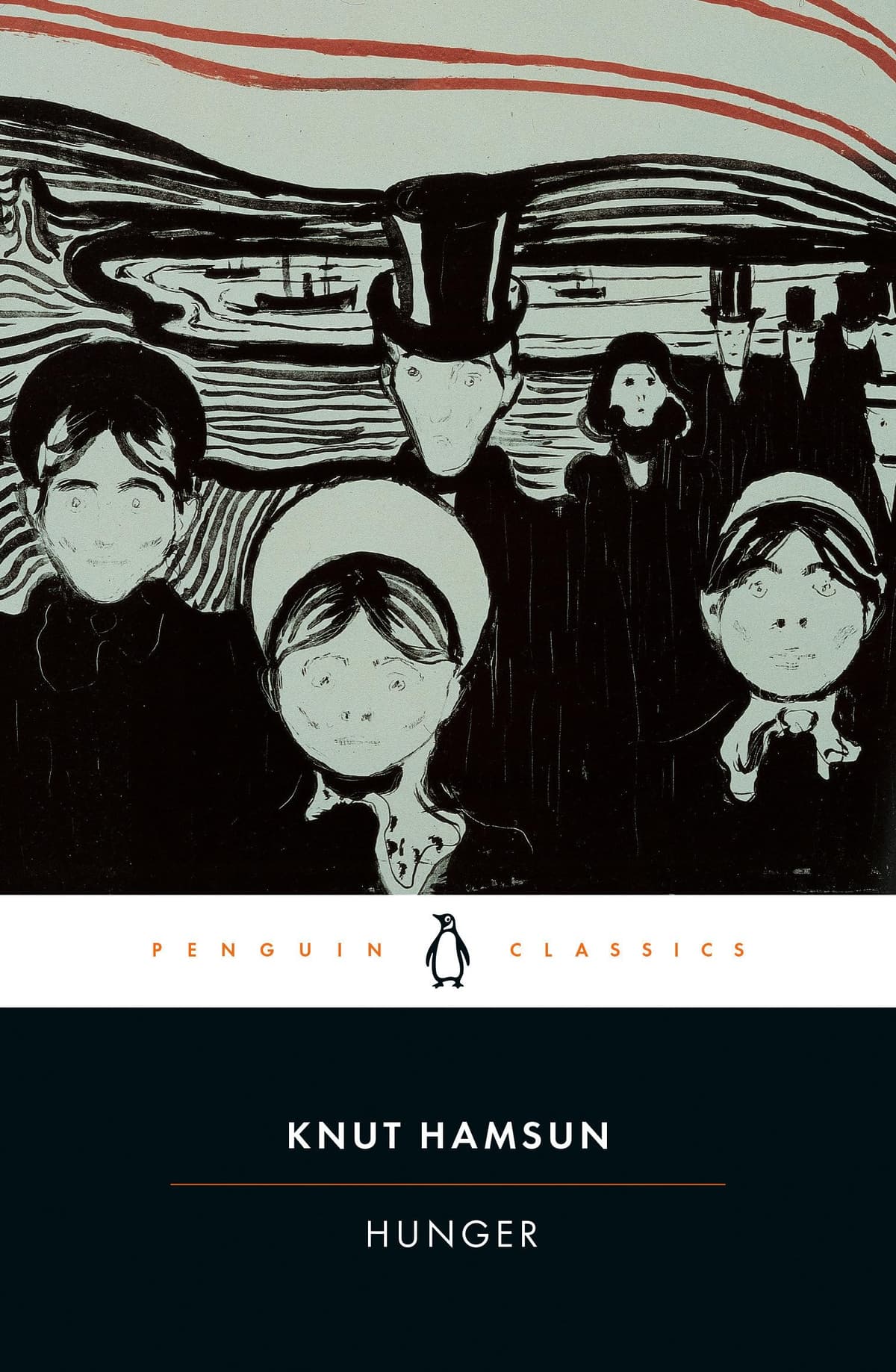
“All of this happened while I was walking around starving in Christiania—that strange city no one escapes until it has left its mark on them.”
Hunger Summary
An unnamed young writer wanders the streets of Kristiania—now Oslo—starving. He has no money, no steady work, and no prospects, yet he refuses charity, pawns his waistcoat, and gnaws on wood shavings rather than admit defeat. The novel follows his erratic course through the city as hunger strips away the civilized self, leaving something raw and unpredictable in its place. He writes feverish articles, applies for jobs he will never get, gives away money he cannot afford to lose, and oscillates between grandiose self-belief and abject humiliation—all while his body slowly consumes itself.
Hamsun's breakthrough novel obliterated the conventions of nineteenth-century realism. There is no plot in the traditional sense—no arc of ambition, courtship, or social climbing—only the minute-by-minute recording of a consciousness under siege. The prose lurches between lucidity and delirium, tracking the way starvation warps perception, fractures logic, and unleashes strange, compulsive behaviors that the narrator himself cannot explain. Published in 1890, it anticipates the stream-of-consciousness technique by decades, and its influence radiates through Kafka, Hesse, Henry Miller, and the entire tradition of the existential novel. Hunger is less a story about poverty than a harrowing, darkly comic exploration of what happens when the mind loses its last anchor to the material world.
Why Read Hunger?
Hunger is one of those rare books that makes you feel a physical sensation as you read. Hamsun plunges you so deeply into his narrator's starving consciousness that you begin to feel the gnawing in your own stomach, the lightheadedness, the strange exhilaration that comes when the body begins to fail. No writer before Hamsun had attempted this level of psychological intimacy—this unblinking focus on the irrational, contradictory movements of a single mind. It is the birth of interior fiction as we know it.
The novel's power lies in its refusal to sentimentalize poverty or turn suffering into a moral lesson. The narrator is proud, absurd, infuriating, and deeply human. His hunger is not metaphorical—it is real, grinding, physical—and yet it becomes a lens through which Hamsun examines the very nature of selfhood. If you have ever felt the gap between who you believe yourself to be and the circumstances that define you, this slim, ferocious novel will speak directly to that wound.
About Knut Hamsun
Knut Hamsun (1859–1952) was born into rural poverty in central Norway and spent his youth in a series of grueling apprenticeships and odd jobs—schoolteacher, sheriff's assistant, streetcar conductor in Chicago—that gave him firsthand knowledge of the hunger and deprivation he would immortalize in fiction. After years of obscurity and failed literary attempts, he published Hunger in 1890, which made his reputation overnight and announced a radical new direction for the European novel.
Hamsun went on to write a series of acclaimed novels including Mysteries, Pan, and Victoria, and won the Nobel Prize in Literature in 1920 for Growth of the Soil. His later life was marred by his support for Nazi Germany during World War II, including a personal meeting with Hitler, which led to his prosecution and disgrace after the war. His literary legacy remains deeply contested—his influence on modernist fiction is immense, yet his political sympathies cast a long shadow. He is at once one of Scandinavia's greatest writers and one of its most troubling figures.
Reading Guide
Ranked #209 among the greatest books of all time, Hunger by Knut Hamsun has earned its place in the literary canon. Originally written in Norwegian and published in 1890, this moderate read from Norway continues to resonate with readers today.
This book belongs to our Modern Mind and Gothic & Dark collections, where you can discover more books that share its spirit and themes.
If you enjoy moderate reads like this one, you might also like One Hundred Years of Solitude, Nineteen Eighty-Four, or Wuthering Heights.
From the Modern Mind Collection
If you enjoyed Hunger, discover more masterpieces that share its spirit.
 #1View Book
Ulysses
James Joyce
Challenging•35-40 hours #2View Book
In Search of Lost Time
Marcel Proust
High•100+ hours #8View Book
The Sound and the Fury
William Faulkner
Very High•12-15 hours #13View Book
Lolita
Vladimir Nabokov
Challenging•12-15 hours
Browse more collections